When pipeline gets shaky, everyone reaches for the same answer: "We need more leads."
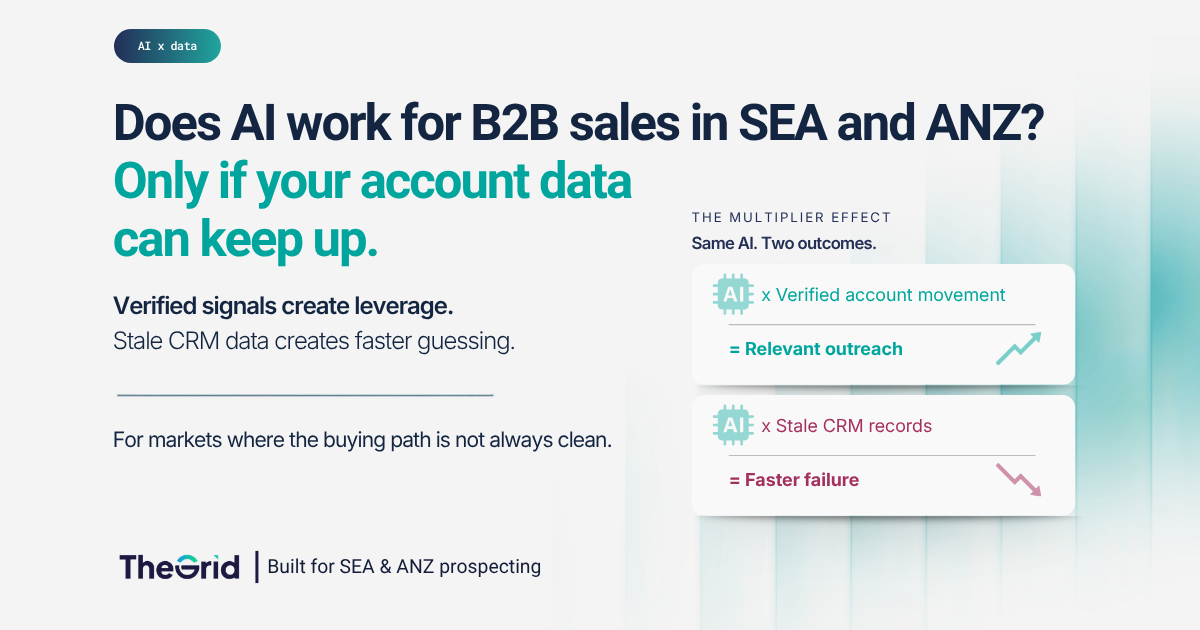
Here's the uncomfortable truth: in Southeast Asia, more data often makes prospecting worse.
Not because volume is bad. Because most of the data your team is using was built for markets that don't behave like SEA — and nobody talks about that.
You're Not Bad at Prospecting. You're Using the Wrong Map.
Picture this...
Your SDR pulls 200 Indonesian logistics companies. Filters by title. Launches a sequence. By Friday — bounced emails, one polite forward, zero pipeline.
The CRM says activity is up. The pipeline feels random.
That's not a messaging problem. That's what happens when you treat data as truth instead of hypothesis.
Global B2B databases assume clean org charts, titles that mean something, and buying intent that shows up online. Southeast Asia breaks all three — systematically, not occasionally.
What the Data Gets Wrong (And What to Do Instead)
Titles don't mean what you think they mean. A "Director" in Jakarta might be a true signer — or the owner's cousin in a gatekeeping role. In SEA, titles are a clue, not a conclusion. Stop filtering by title. Start mapping four roles per account: who feels the pain, who runs the process, who controls the budget, and who actually signs.
"The company" is often three companies. SEA runs on holding structures, shared brands, and subsidiaries that operate independently. You can target the right account name and still talk to the wrong entity entirely. Always validate which operating entity owns both the problem and the budget.
Real buying intent happens where your dashboard can't see. A CFO in Manila asking founder friends "who are you using for X?" in a WhatsApp group — that's buying intent. It just doesn't register anywhere. Teams chasing web-based intent signals in SEA are missing half the market. Watch for operational change instead: new hires in Finance or Ops, expansion into new cities, systems migrations, leadership appointments. Those are the signals that actually precede a purchase.
The decision-maker is rarely in the room. Evaluations happen across committees. But in SEA, one person almost always decides — and it's usually the founder, GM, or country head who never joined a single demo call. Find the approval path early. Build messaging your internal champion can forward without editing.
The 15-Minute Shadow Org Chart
Before any account enters your sequence, do this:
- Pain owner — who feels the problem daily?
- Process owner — who runs the workflow you're selling into?
- Budget owner — who actually controls spend? (Hint: often not Finance.)
- Final signer — founder, GM, or regional head?
Can't answer all four in 15 minutes? Your outreach should surface them — not try to convert them.
This single habit separates reps who get replies from reps who get ignored.
Signal-Led > List-Led
Most teams run: static list → sequence → hope.
The teams getting replies in SEA run: company in motion → map the buyer → outreach anchored to a real trigger.
The message doesn't need to be clever. It needs to be timely and accurate. That's the gap.
Where TheGrid Comes In
If the root issue is visibility — who's real, who holds authority, who's actually moving — then better B2B prospecting in Southeast Asia requires better regional signals.
TheGrid is built for exactly that: a signal discovery engine and visibility layer for SEA that surfaces relevant companies, real decision-makers, and buying signals that reflect how this region actually operates.
Not a replacement for strategy. Just what removes the blindfold while you execute it.
Curious what that visibility looks like in practice?
If you want a clearer view of who’s moving in SEA, TheGrid is worth a look: sgpgrid.com
FAQs:
- Why doesn’t intent data work well in Southeast Asia?
Because a lot of buying intent happens in private channels (peer referrals, WhatsApp groups, partner intros, offline events) and many companies have inconsistent digital footprints—so “web intent” alone misses real in-market activity.
- What are strong buying signals in Southeast Asia?
Look for operational change: leadership hires in Ops/Finance/IT, expansion to new branches/cities, systems migration projects, new partnerships that force workflow changes, and compliance deadlines that create urgency.