Sales professionals today have a wealth of frameworks at their disposal to qualify prospects and manage complex sales cycles.
Three popular methods—SPICE, BANT, and MEDDIC—offer distinct approaches to evaluating opportunities and guiding conversations with potential customers. Below, we explore each framework in detail, discussing what makes them effective as well as some potential drawbacks.
SPICE Framework
The SPICE framework is designed to help sales teams quickly assess a prospect’s situation and identify key challenges. The acronym can be broken down as follows:
- Situation: Understand the current environment and context of the prospect.
- Pain: Identify the primary challenges or problems they are facing.
- Impact: Evaluate the consequences these issues have on the business.
- Critical Event: Recognize any upcoming deadlines or events that might accelerate a decision.
- Evaluation: Determine how your solution aligns with the prospect’s needs.
Pros:
- Encourages a thorough understanding of a prospect’s background and pain points.
- Helps uncover pressing deadlines or events that may drive urgency.
- Streamlines the qualification process by focusing on key decision factors.
Cons:
- Can oversimplify more complex or multifaceted sales scenarios.
- Requires detailed insights from the customer, which aren’t always available early on.
- May need additional training for effective application across diverse industries.
Best for:
- Sales Discovery Calls, Value-Based Selling, Challenger Sales Model.
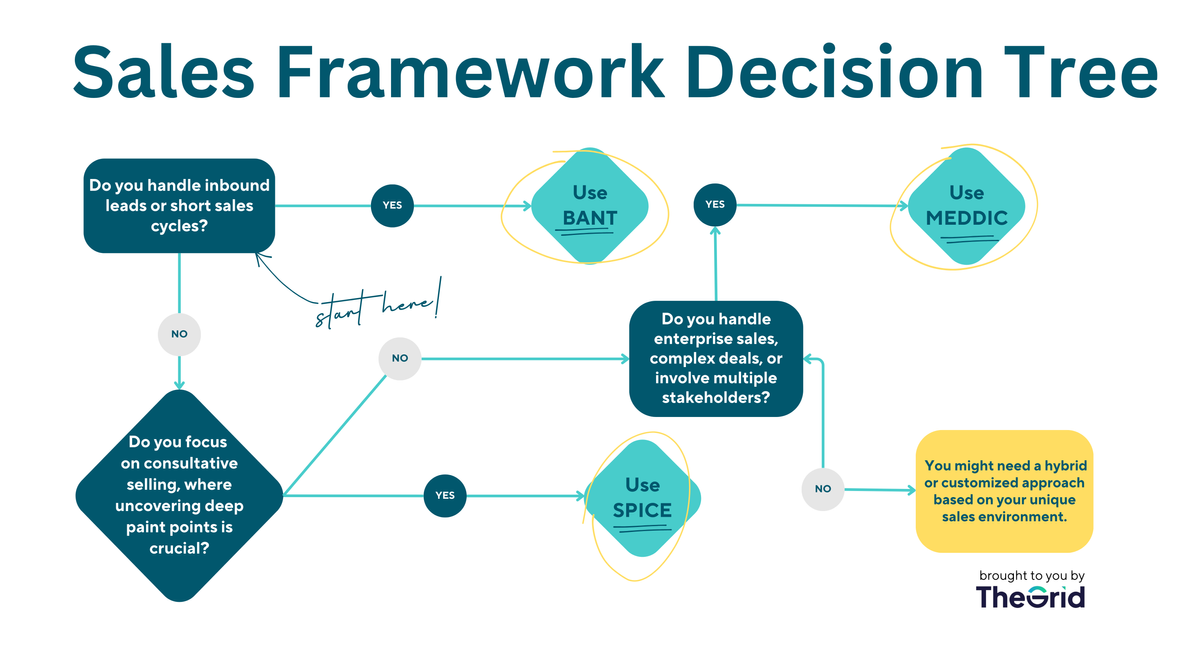
- Best for products/services which require consultative selling, where the team needs to uncover deeper pain points and educate buyers on why they need your solution.
BANT Framework
BANT is a modern twist on the traditional BANT model. By adding an extra layer of scrutiny, it aims to refine the qualification process further. The BANT acronym typically stands for:
- Budget: Confirm that the prospect has the financial capacity to invest.
- Authority & Autonomy: Identify the key decision-maker who holds the purchasing. power and ensure that the decision-maker has the freedom to act without excessive external constraints.
- Need: Establish that there is a significant business need that your solution can address.
- Timing: Understand the timeframe in which the prospect plans to make a decision.
Pros:
- Offers a straightforward, easily digestible checklist for qualifying leads.
- Helps sales teams quickly focus on prospects that meet essential criteria.
- Integrates well with other sales processes by providing clear, actionable insights.
Cons:
- May oversimplify complex buying environments by emphasizing a limited set of factors.
- Risks neglecting the nuanced relationships and dynamics that can influence a sale.
- Assumes that budget and authority are the most critical elements, which might not always be the case in consultative sales.
Best for:
- Inbound SDRs, High-Velocity Sales, SMB & Mid-Market Deals.
- Teams which deal with a large number of inbound leads or shorter sales cycles (SMB to Mid-Market).
MEDDIC Framework
MEDDIC is renowned for its holistic approach to sales qualification, particularly in high-value, complex sales cycles. The framework is built around six key components:
- Metrics: Identify quantifiable outcomes and performance indicators that the prospect cares about.
- Economic Buyer: Pinpoint the individual who has the final say on financial matters.
- Decision Criteria: Understand the specific factors the prospect will use to evaluate options.
- Decision Process: Map out the steps and stakeholders involved in the decision-making process.
- Identify Pain: Recognize the core challenges or pain points driving the prospect’s interest.
- Champion: Cultivate an internal advocate who can help push your solution through the organization.
Pros:
- Provides a detailed roadmap for understanding both the prospect’s needs and their decision-making process.
- Focuses on measurable outcomes, which can help in building a compelling business case.
- Emphasizes the importance of internal champions to ensure long-term success.
Cons:
- Can be time-consuming to implement fully, especially in fast-paced sales environments.
- Demands a high level of discipline and training from sales teams to apply effectively.
- May feel overwhelming in early conversations if too many details are probed too soon.
Best for:
- Enterprise Sales, Complex Deals, Outbound SDRs & Account Executives (AEs).
- Selling to large enterprises where multiple stakeholders are involved, and deals take longer to close.

Final Thoughts
Each framework—SPICE, BANT, and MEDDIC—offers unique insights into the sales process. SPICE emphasizes rapid qualification through situational and impact analysis, BANT refines the classic model by adding autonomy, and MEDDIC provides a deep dive into metrics and internal dynamics. The choice of framework depends largely on your organization’s sales cycle, the complexity of the deals, and the specific needs of your team. In practice, many sales teams benefit from blending elements of these frameworks to create a tailored approach that drives both short-term wins and long-term customer success.
How TheGrid Can Elevate Your Sales Prospecting
No matter which sales framework you use—SPICE, BANT, or MEDDIC—having access to accurate prospect data is key to closing deals faster. TheGrid empowers sales teams with advanced lead intelligence to accelerate your sales pipeline.
🚀 Ready to supercharge your sales process? Explore TheGrid now and see how we can help you win more deals.