More pipeline. More outreach. More volume.
That's the default prescription when sales stalls. Run more sequences. Buy a bigger list. Add more accounts to the CRM. Keep the activity numbers up.
But here's the thing nobody wants to say in the Monday morning sales call:
Volume is not a strategy. It's a way of avoiding the real problem.
In Southeast Asia, the teams closing deals aren't the ones sending the most emails. They're the ones who know exactly who they're talking to, why that person can actually decide, and why right now is the right moment to reach out.
That's not a volume advantage. That's a quality advantage.
The Pipeline That Looks Full But Feels Empty
A sales leader at a B2B software company in Singapore once described her team's pipeline as "a beautiful lie."
300 accounts in the CRM. Sequences running. Follow-ups scheduled. Green across the board on the activity dashboard.
But when she sat down with each rep and asked "who is the actual decision-maker at your top ten accounts?" the answers were thin. Job titles. LinkedIn profiles. Best guesses.
Nobody could confidently name the person who would sign the contract. Nobody knew if those accounts were even in a buying cycle. And at least a third of the contacts hadn't been validated in over a year.
The pipeline wasn't real. It was organized noise.
This is the quantity trap and it's everywhere in SEA sales teams right now.
Why "More Leads" Fails Specifically in Southeast Asia
The volume playbook was built for markets with clean data, transparent org structures, and predictable buying behavior. Southeast Asia is none of those things.
Decision-making is layered and often invisible. In Manila, the VP of Operations might run the evaluation but the founder makes the call over a family dinner. In Jakarta, the "Head of Procurement" exists to filter vendors, not evaluate them. The real buyer is three layers up and completely off your radar.
Org charts are fiction. Family-run conglomerates, holding group structures, and subsidiaries with shared brand names are the norm across PH, MY, ID, and SG. The company you're targeting on paper might be three separate legal entities in practice with budget sitting in a completely different one.
Data decays faster than most teams realize. Research cited by HubSpot estimates B2B contact data decays at roughly 22.5% per year, meaning close to one in four records becomes inaccurate within twelve months. In Southeast Asia, where job movement is frequent and organizational structures change without clear public updates, it’s reasonable to expect at least similar and often worse effective accuracy over time, especially if you’re relying on static lists or global databases that refresh infrequently.
Adding more leads to a leaking pipeline doesn’t fix the leak. It just gives you more to clean up. (Source: HubSpot, citing Marketing Sherpa — hubspot.com/database-decay)
Adding more leads to a leaking pipeline doesn't fix the leak. It just gives you more to clean up.
What "Quality Prospecting" Actually Means
Before getting into frameworks, here's a working definition worth bookmarking:
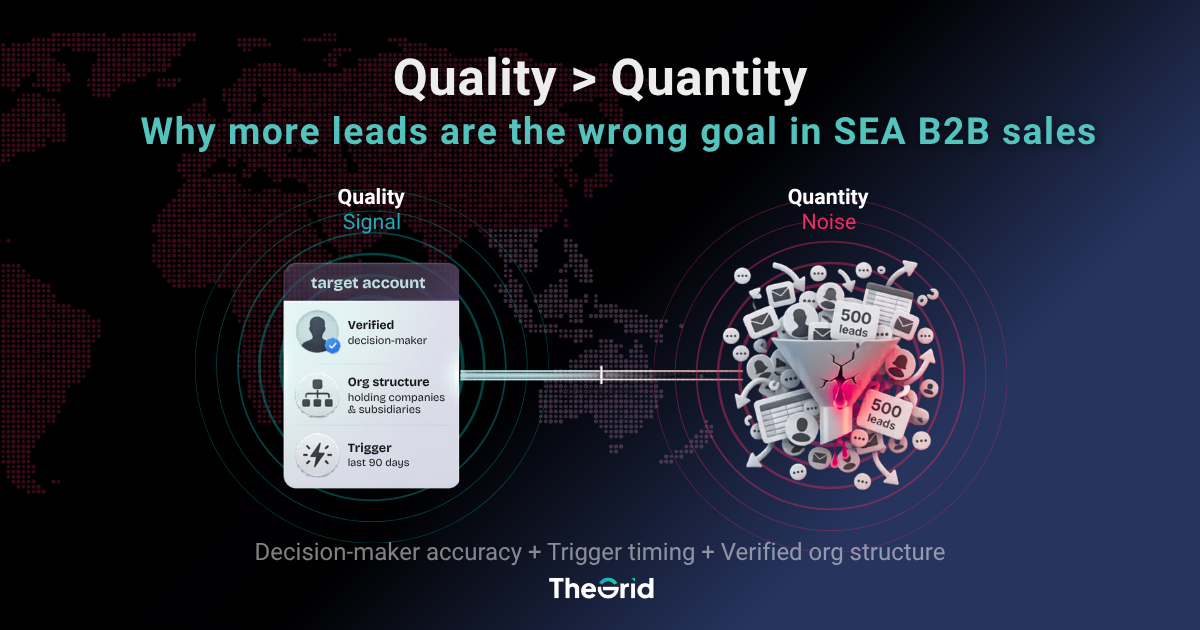
Quality prospecting = decision-maker accuracy + buying-trigger timing + verified org structure
If you only remember one thing:
Quality prospecting is a three-part filter — and all three parts have to be true.
Right person: you can name the actual decision-maker (not just a senior title).
Right company: you’ve verified where budget and authority actually sit (entity vs holding group vs procurement gate).
Right moment: you can point to a real change in the last 90 days that makes outreach defensible.
Miss any one of these, and you're not "early." You're just irrelevant.
The Real Problem: Quantity Hides a Targeting Failure
Here's the honest diagnosis most sales leaders resist:
When pipeline isn't converting in SEA, the instinct is to blame messaging, cadence, or rep effort. Those are visible and fixable. But the actual failure usually happened upstream in who was targeted, whether they could actually decide, and when they were reached.
That's a targeting quality problem. And no amount of volume solves it.
Consider what actually drives a reply in SEA:
- Reaching the right person, not just the right title
- At a company that is genuinely in motion: expansion, restructure, new leadership
- With a reason anchored to something real happening right now
Miss any one of those three and the sequence doesn't matter. The copy doesn't matter. The follow-up cadence doesn't matter.
Timing beats volume. Signal beats noise. Quality beats quantity, every time.
SEA Mini Case Vignette: Singapore Fintech Selling Into PH Enterprise
A Singapore-based fintech selling treasury management software had been prospecting Philippine conglomerates for two quarters with little traction. Their list was clean by global standards: Fortune 500-equivalent PH companies, correct industry filters, senior Finance titles.
The problem emerged when they mapped the actual decision chain:
Who they were emailing: VP of Finance at the Philippine subsidiary
Who actually decided: Group CFO at the holding company, based in Makati, not listed on any database they used
Who blocked them: A procurement team that only engaged after internal sign-off, not before
What finally opened the door: A trigger they almost missed. The holding group had just announced a regional treasury consolidation across three markets. That single operational signal, surfaced through a company movement alert, gave the rep a specific, timely reason to reach out to the right person at the right level.
One trigger. One accurate contact. One real conversation.
That is quality prospecting in practice.
The Quality Prospecting Checklist for B2B Sales in SEA
Treat this as a pre-flight check. If an account fails the checklist, the correct action isn’t “sequence harder”, it’s “wait and watch,
Save this. Run every account through it before sequencing.
Step 1: Decision-Maker Accuracy
- Can I name the actual budget owner, not just a title?
- Is this person at the operating entity or a holding company above it?
- Has this contact changed roles in the last six to twelve months?
- Is there a founder, GM, or country head who makes the final call?
Step 2: Org Structure Verification
- Is this company a standalone entity or part of a group?
- Does budget sit locally or at a regional or global HQ?
- Is there a separate procurement entity that controls vendor onboarding?
Step 3: Trigger Validation
- Can I point to one concrete company-level change in the last 90 days?
- Does that change create urgency, budget movement, or a process gap?
- Can I explain why this account, why now, in one sentence?
If you cannot check every box: monitor the account. Do not sequence it yet.
For a deeper look at how to apply this across your pipeline, see how teams are using TheGrid for sales prospecting.
The Quality Signals That Actually Precede a Purchase in B2B Sales in SEA
Forget generic intent data. In Southeast Asia, the signals that reliably precede a buying decision are tied to operational change, not content consumption.
Watch for:
- Leadership appointments in Finance, Operations, or IT: new leaders arrive with mandates and often trigger vendor reviews
- Hiring ramps in functions adjacent to your solution: headcount growth exposes workflow gaps
- Expansion into new cities or markets: growth creates process strain and opens budget conversations
- Systems migrations: moving ERP, CRM, or core ops platforms forces adjacent tool evaluations
- New partnerships or joint ventures: structural changes that force process and workflow reviews
- Compliance deadlines: regulatory milestones that create non-negotiable urgency
These signals don't require guesswork. They require watching the right layer of the market, which is a fundamentally different activity from buying a bigger list.
(Supporting framework: account-based marketing research consistently shows that trigger-based outreach outperforms cold volume outreach in conversion rate. Source: ITSMA Account-Based Marketing Survey — itsma.com)
If your current data provider isn't surfacing these signals for SEA markets, it may be worth reviewing your data enrichment setup before your next prospecting cycle.
Quantity Motion vs. Quality Motion
| Quantity Motion | Quality Motion |
Starting point | Static list of 500 accounts | 50 accounts showing operational movement |
Filter logic | Industry and revenue | ICP plus active trigger |
Contact approach | Title match | Decision-maker mapped by role |
Outreach reason | "You fit our profile" | Specific trigger anchored to real change |
Measurement | Emails sent, activity logged | Pipeline per account touched |
SEA outcome | High bounce, low reply | Fewer touches, more real conversations |
The quality motion takes more thinking upfront. It produces fewer touches. And it generates significantly more pipeline per account touched.
LinkedIn's research on B2B buying behavior supports this: buyers are far more likely to respond to outreach that demonstrates situational awareness than to generic personalization. (Source: LinkedIn B2B Institute — linkedin.com/business/marketing/b2b-institute)
Where TheGrid Fits Into This
The quality prospecting motion above has one prerequisite: visibility
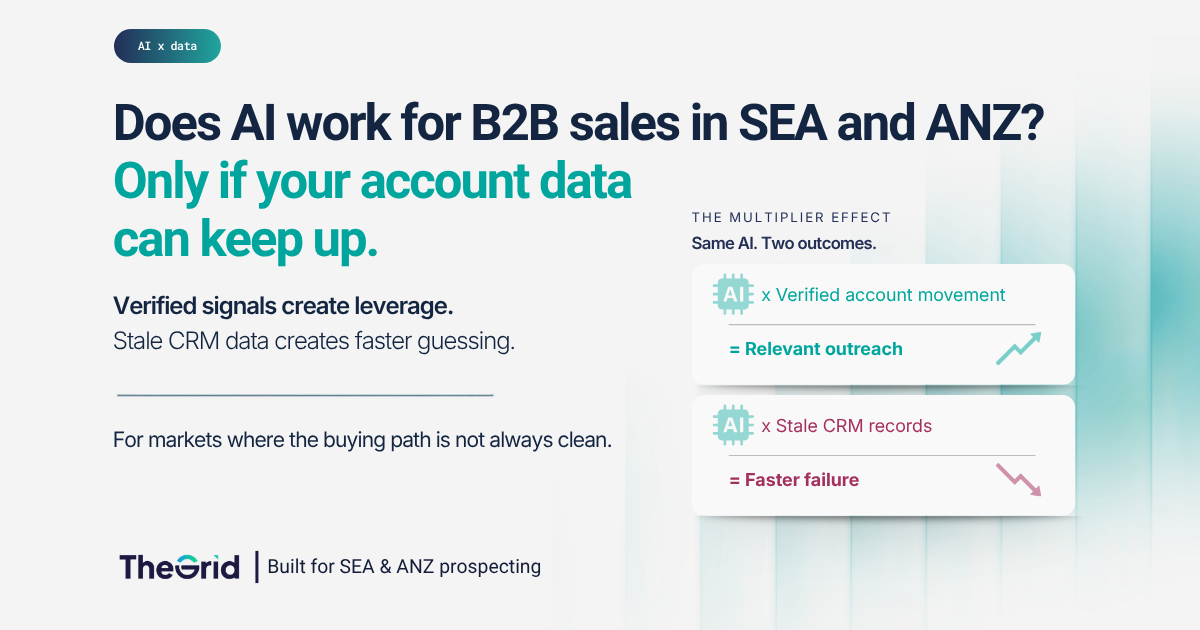
If you can’t see the decision chain, the org structure, or what’s changing inside an account, you default back to volume — not because it works, but because it’s measurable.
TheGrid is built to support the three requirements of quality prospecting in Southeast Asia:
- Decision-maker accuracy: Surface the real budget owners and signers beyond misleading titles — including the people sitting above the operating entity.
- Buying-trigger timing: Detect company movement signals (leadership changes, expansion, system shifts, restructuring) so outreach is anchored to why now.
- Org structure verification: Map groups, subsidiaries, and procurement gates so teams don’t spend quarters selling into the wrong entity.
Teams also use TheGrid for CRM enrichment, keeping contact and company data accurate between prospecting cycles.
Not more leads. The right ones.
Before You Add Another 200 Accounts to the CRM
Ask yourself honestly:
- Do you know the actual decision-maker at your top 20 accounts, not just a title?
- Do you know which of those accounts are in motion right now?
- Can every rep on your team explain why this account, why now, in one sentence?
If any of those feel uncertain, the fix isn't more volume.
It's better visibility into the market you're already trying to win.
Want to see what “quality prospecting” looks like on a real account?
View a sample account-in-motion breakdown → sgpgrid.com
Frequently Asked Questions
Why doesn't outbound volume work in Southeast Asia?
Because SEA buying behavior doesn't follow the assumptions that volume playbooks were built on. Org structures are opaque, decision-makers are often invisible in standard databases, and a large portion of buying intent surfaces through private channels like peer referrals, WhatsApp groups, and offline events. Volume without targeting accuracy just accelerates contact with the wrong people at the wrong time.
How do I find the real decision-maker in SEA companies?
Start by mapping four roles per account: the pain owner who feels the problem, the process owner who runs the workflow, the budget owner who controls spend, and the final signer who is often a founder, GM, or country head not listed in any public database. Use your initial outreach to confirm which role each contact holds rather than assuming authority from a title.
What are the best buying triggers for B2B sales in Southeast Asia?
The most reliable triggers are tied to operational change inside a company: leadership appointments in Finance, Operations, or IT; hiring ramps in functions adjacent to your solution; expansion into new cities or markets; systems migrations; new partnerships that force workflow changes; and compliance deadlines with hard timelines. These signals precede a purchase far more reliably than web-based intent data in this region.
What is account-based prospecting and how is it different from lead generation?
Lead generation focuses on volume: attracting or capturing as many contacts as possible and filtering later. Account-based prospecting works in reverse: you identify a specific set of high-fit accounts first, map the real decision chain inside each one, and only reach out when a defensible trigger exists. In SEA, where data quality is patchy and decision-making is relationship-gated, the account-based approach consistently outperforms volume-led lead generation.
Why is B2B data accuracy a bigger problem in Southeast Asia than other regions?
SEA companies frequently operate through holding group structures, subsidiaries, and shared brand identities across multiple legal entities. Job mobility is high, titles are inconsistently applied, and company changes often happen without public announcements. This means global databases built on English-language web signals and standardized org structures are structurally misaligned with how SEA businesses actually operate.
How often should I refresh my contact data for SEA prospecting?
At minimum every six months, though quarterly is better for active accounts. Research cited by HubSpot puts global B2B data decay at roughly 22.5% per year. In SEA markets where structural change and job movement happen faster and with less public visibility, decay rates are likely higher. Treating your buyer list as a static asset is one of the most common and costly mistakes in SEA outbound.
References:
- HubSpot Database Decay Simulator (citing Marketing Sherpa): hubspot.com/database-decay
- DemandScience — B2B Data Deprecation Guide: demandscience.com/resources/blog/b2b-data-deprecation-marketers-guide
- Forbes Business Council (citing Gartner on data decay): forbes.com/councils/forbesbusinesscouncil/2024/04/18/the-b2b-data-decay-epidemic
- ITSMA Account-Based Marketing Survey: itsma.com
- LinkedIn B2B Institute — Buyer Behavior Research: linkedin.com/business/marketing/b2b-institute
- LinkedIn Work Change Report: economicgraph.linkedin.com/research/work-change-report