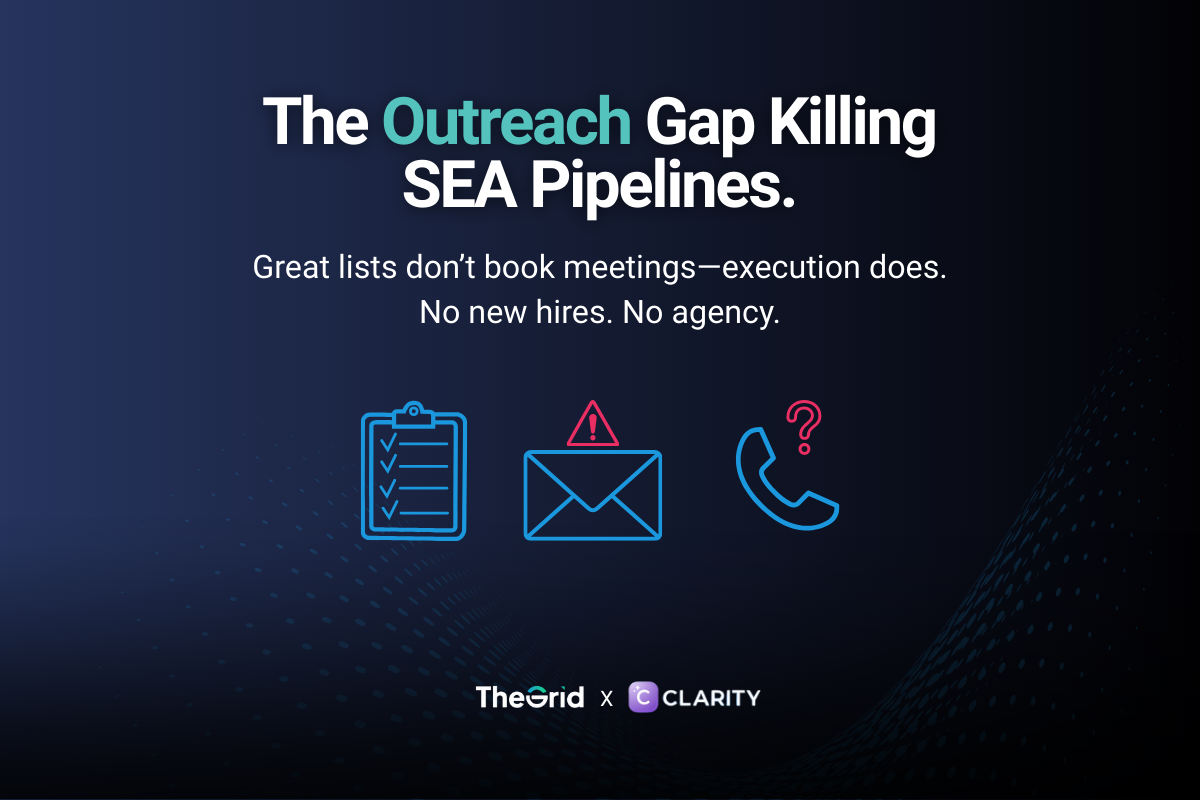
Most teams don’t lose deals—they lose momentum between a “good list” and the first reply.
That gap is where the pipeline goes to die. Not because your data is wrong, but because execution gets inconsistent at the moment the list is ready.
Here’s a simple example of what that looks like in the wild:
Bad: “Saw you’re hiring—would love to connect.”
Better: “Noticed you’re hiring 3 SDRs in Singapore—does that signal pipeline coverage is a priority this quarter?”
Same company. Same person. Totally different intent.
The problem isn’t that teams don’t know who to contact anymore. It’s that most teams don’t have a reliable way to turn insight into conversations—day after day—without hiring a small army or outsourcing to a traditional agency.
Insight is everywhere. Momentum isn’t.
Modern B2B teams have access to better tools, deeper databases, and more granular filters than ever.
You can identify the right company, the right role, and even the right seniority level in minutes.
And yet pipelines still stall—especially across SEA, where selling cycles are relationship-heavy, and inbox trust is fragile.
The reason is simple but uncomfortable:
Insight creates clarity. But clarity alone doesn’t create momentum.
Momentum only happens when insight is translated into consistent, thoughtful execution. That’s where most B2B outreach quietly breaks down.
Why LinkedIn outreach feels harder than it used to
In SEA B2B sales, LinkedIn outreach and prospecting only work when relevance and timing are treated like strategy—not admin.
If outreach feels harder today, it’s not your imagination.
Despite having more data and more automation, many teams see the same symptoms:
- Low reply rates
- Conversations that go cold after the first message
- Opportunities that never quite materialize
It’s tempting to blame targeting or data quality.
But most of the time, the list is fine.
The breakdown happens after the list is built—when execution gets rushed, overly automated, or deprioritized entirely.
LinkedIn became “Bulk Email 2.0” (and buyers tuned out)
LinkedIn used to feel like a relationship channel. Today, it often feels like a sequence channel.
Many teams still rely on:
- Generic connection requests
- Copy-paste opening lines
- Automated follow-ups sent on rigid schedules
From the buyer’s perspective, it’s instantly recognizable—and not in a good way.
It doesn’t signal intent.
It signals automation.
Once someone senses your message is part of a sequence rather than the start of a conversation, trust drops fast. And in B2B, trust is the currency that decides whether a conversation continues or dies quietly in the inbox.
In SEA, relationships amplify everything—so when your first message feels automated, the penalty is higher.
Why hiring won’t fix this (especially in SEA)
“Just hire SDRs” sounds like the obvious answer—until you try it.
Even when you find good SDRs, you still run into the same reality:
- Ramp time takes weeks (sometimes months)
- Consistency depends on coaching, QA, and constant iteration
- Turnover resets momentum
- Leadership ends up managing cadence instead of improving conversations
Hiring can increase activity. But it doesn’t automatically create a repeatable execution layer—the system that turns insight into consistent, high-quality outreach.
And that’s the real constraint most SEA teams are feeling.
The execution layer (the part nobody tools for)
Strong data leads to strong lists. But lists don’t book meetings.
Conversations do.
The missing piece is what we’ve started calling the execution layer—the part between insight and inbox that determines whether outreach actually lands.
It includes:
- Insight → what to say (and what not to say)
- Timing → when to reach out (based on real signals, not arbitrary cadence)
- Consistency → doing it every day without quality dropping
- Feedback loop → improving the approach after 20–50 touches
In practice: signals → 3 conversation angles → opener + follow-up logic → weekly iteration
Most teams know they need this. They just don’t have the capacity to build it.
That’s why The Grid × CClarity are testing an execution layer that sits between insight and inbox—so teams can run high-touch outreach without building an SDR team or paying for a traditional agency retainer.
What actually works in modern LinkedIn outreach
The teams getting consistent results have shifted away from volume tactics and toward:
- Smaller, higher-intent account lists
- Messages grounded in relevance (not templates)
- Outreach timed around real growth or buying signals
- Conversations designed to open dialogue—not force a pitch
This doesn’t scale through brute force.
It scales through discipline and intent.
And the payoff is tangible: better replies, faster meetings, and first calls that begin with trust already established.
Where momentum is won or lost
At this point, identifying decision-makers isn’t the hardest part of B2B sales.
The real challenge is:
Turning insight into consistent, high-quality execution—day after day.
This is where most outreach strategies fail. Not because data is bad, but because execution becomes inconsistent, diluted, or overly automated.
Momentum is fragile. Execution is what sustains it.
A new pilot we’re running from insight to conversations
The Grid has spent years helping teams gain clarity through high-quality, localized business intelligence across SEA and ANZ.
CClarity has focused on turning clarity into sharper commercial narratives and outreach that actually sounds human.
Together, we kept noticing the same pattern:
Teams knew exactly who to reach.
They just couldn’t execute outreach at the level required to convert—consistently.
So we’re piloting a conversation-first execution support, the LinkedIn Growth Accelerator. Designed to close the gap between insight and pipeline.
What it’s designed to do:
- Run high-touch LinkedIn outreach without spam
- Apply conversation-first frameworks that feel human
- Reduce reliance on generic automation
- Measure success by qualified meetings booked, not messages sent
This isn’t about sending more.
It’s about creating the conditions for better conversations to happen.
Final thought
B2B outreach doesn’t fail because of bad data.
It fails when execution breaks down.
The teams that win aren’t louder. They’re more deliberate.
And in a crowded inbox, intention is still what cuts through.
Want to see how this works in practice?
If you’re exploring a more execution-led approach to B2B LinkedIn outreach, we’re inviting a small group of SEA teams to preview the pilot.
No pressure. Just a practical look at what “execution layer” support could look like for your team.