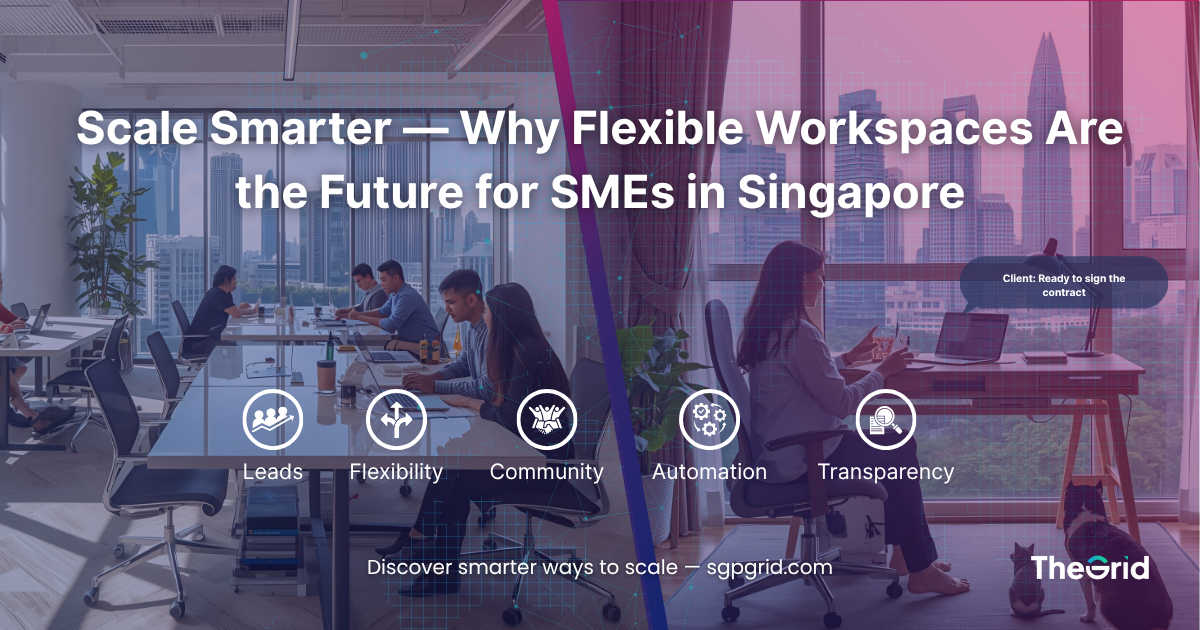
The Hidden Costs of Growth: When Expansion Becomes a Liability
Imagine this: you’re running a lean, agile SME in Singapore. Things are going well. You land a handful of new clients, hire more people, and decide it’s time to scale. So, you sign a 3- to 5-year lease for a traditional office, commit a hefty deposit, pay for renovation, furnishing, utilities, and now you’re locked into that space even if your headcount fluctuates.
Fast forward a year — you over-hired, or market conditions shifted, or a subsidiary underperforms. You’re stuck with empty desks, debt obligations, and a lease you still have to pay. Worse, you spent weeks managing fit-out, IT infrastructure, wiring, supplier quotes, and approvals — time that could’ve gone into sales, product, or customer success.
Unfortunately, this scenario isn’t rare. Many SMEs fail to anticipate how unpredictable growth trajectories can be. Expansion “mistakes” like overcommitting to space, choosing a poor location, or misjudging cash flow create drag on momentum. Add to that rising commercial rents in Singapore, long lead times in property transactions, and the administrative overheads of facilities, and you end up bleeding both time and capital.
In other words: scaling fast rarely means scaling smoothly — not when your workspace is a rigid liability.
The Shift: From Fixed Offices to Flexible Workspaces
This is where flexible workspaces (coworking, serviced offices, hybrid setups) enter the picture as a smarter alternative. Rather than force-fitting your growth into a rigid real-estate contract, flexible workspaces allow you to scale with your business, not ahead of it.
Some of the key advantages:
- Pay only for what you use
Rather than lease an entire floor, you can start with a few desks or private rooms, then scale up or down without breaking contracts. You avoid paying for unused capacity.
— Shared or flexible offices bundle utilities, cleaning, furniture, and amenities into one package. Start your brand journey+2SG Serviced Offices+2 - Faster move-in, less friction
A flexible workspace is ready to use — desks, internet, meeting rooms — so you skip weeks or months of build-out. WeWork+2FlySpaces Blog+2 - Prime location access without premium risk
Flexible workspaces are often in central business districts or business hubs. You benefit from prestige, access to transport, and proximity to clients — without long-term exposure. World Business Outlook+2SG Property Wiki+2 - Built-in community, networking, and serendipity
Sharing space with other SMEs, startups, freelancers, and even larger firms fosters idea exchange, referrals, or partnerships. JustCo+2WeWork+2 - Flexibility in times of change
In downturns, you can shrink rather than being stuck. In growth spurts, you can expand seamlessly. This resilience is essential in volatile markets. SG Property Wiki+2theinstantgroup.com+2 - Focus energy on your core business
You offload facility management, vendor contracting, and admin hassles — freeing your team to do what they do best: building, selling, and delighting customers.
Singapore’s flexible workspace market has been booming between 2014 and 2022, the total workspace footprint tripled (from ~1.2 million sq ft to ~3.7 million) to meet demand. FlySpaces Blog Meanwhile, in 2022, Singapore saw a ~25 % surge in flexible workspace inquiries, with increasing demand for spaces of 10+ desks. T1 Glass
SME leaders in Singapore are also rethinking priorities: cost and location remain important, but decision-makers increasingly demand functionality, wellness, and adaptability in their workspace choices. ISCA Chartered Accountants Lab
The Grid: Your Shortcut to Smarter, Faster Scaling (Without Workspace FOMO)
At The Grid (sgpgrid.com), we believe workspace strategy should serve — not stifle — your scaling ambitions. While we’re not a workspace provider ourselves, we act as a B2B sales intelligence and scaling accelerator for SMEs. And here’s how that mission synergistically aligns with flexible workspaces.
- Strategic site insights & expansion leads
As you evaluate physical expansion — say, into a new office location or satellite team — The Grid helps you surface high-potential market sectors, prospect companies, and demand clusters. That way, when your team co-locates in flexible workspaces, you already have leads tailored to those geographies or verticals. - Validate presence, then commit
A common risk in scaling is committing too early. With flexible workspaces, you can “plant a flag” in a new zone or district, test traction for 6–12 months, and only commit to more permanent leases when your pipeline through The Grid justifies it. In this way, your physical footprint evolves as your sales data evolves. - Efficient go-to-market support
When you deploy new sales teams, field agents, or support staff near clients, flexible workspaces remove the friction of setting up infrastructure. The Grid’s insights guide where to place those resources for maximum ROI. - Reduce overhead drag on growth capital
By avoiding heavy upfront CAPEX on facilities, you preserve cash, runway, and flexibility. That keeps your burn rate lean, letting you pour more into product, marketing, or hiring — guided by The Grid’s intelligence. - Adapt to market shifts with agility
Should your strategy pivot — say, you shift focus from one industry cluster to another — you can reconfigure your workspace footprint more nimbly. And The Grid’s real-time intelligence helps you spot those shifts before they blindside you.
Best Practices for SMEs Choosing Flexible Workspaces in Singapore
To make this approach meaningful (not just fashionable), here are a few tips:
- Focus on growth corridors
Use The Grid data (or your market intelligence) to pick a workspace in zones where your ideal clients cluster, rather than purely chasing the cheapest rent. - Negotiate flexibility
Even in flexible spaces, try to maintain optionality (shorter notice, upgrade rights) so you’re not locked for months beyond usefulness. - Check tech and infrastructure
Ensure the space has reliable broadband, meeting rooms with AV, privacy booths, and secure networks. - Bring your brand into the space
Though shared, you should be able to customize signage, branding, and meeting rooms to reinforce your identity. DB&B Singapore - Measure utilization vs. cost
Track desk/room usage over time. If you see underuse, renegotiate or optimize your footprint rather than blindly renewing. - Maintain a core “home base” team
Even if many staff are hybrid, keeping a stable nucleus helps maintain culture, knowledge transfer, and coordination.
Ready to Scale Smarter — Not Harder?
Your workspace should evolve with your business, not hold it back.
Whether you’re expanding into new districts, testing hybrid models, or scaling your sales operations, the right data can help you make every move count.
The Grid empowers Singapore SMEs to:
Identify high-potential markets before committing to new offices
Align workspace decisions with real demand and verified sales opportunities
Scale confidently with live B2B insights — without the guesswork
Start your smarter scaling journey today.
Explore The Grid’s Growth Intelligence Platform — your shortcut to faster, data-driven expansion in Singapore and across Southeast Asia.
See how Singapore’s top-performing SMEs are scaling smarter.
Check out The Grid’s Top 20 SMEs in Singapore — discover who’s leading the way and what’s driving their growth momentum.