For years, LinkedIn has been positioned as a scalable channel for B2B outbound.
With the rise of automation tools, the promise was simple: send more messages, reach more prospects, and book more meetings faster.
But in practice, most teams experience the opposite. Reply rates decline. Conversations stall. And even when responses come in, they rarely convert into meaningful sales discussions.
The problem isn’t LinkedIn itself. And it definitely isn’t personalized as a concept. The actual problem is how outreach is executed after the message is sent.
The Automation Trap: When Scale Works Against You
Bulk LinkedIn automation was built to solve one problem: effort. Instead of manually researching prospects and writing messages, teams could rely on:
- Connection request templates
- Pre-written follow-ups
- Fixed sequences triggered by time, not context
At first, this felt efficient. But over time, buyers adapted. Today, most decision-makers can recognize automated outreach within seconds, not because the tools are bad, but because automation strips away intent.
The result is predictable:
- Messages get accepted but ignored
- Replies are short, defensive, or non-committal
- Conversations feel transactional instead of exploratory
Automation optimized sending, but it didn’t optimize engagement.
Why Personalized Outreach Still Wins on LinkedIn
Personalized LinkedIn outreach works not because it’s clever, but because it respects how B2B conversations actually start.
Real conversations don’t follow scripts. They respond to context. Effective personalization isn’t about inserting a first name or company field. It’s about showing that:
- You understand why this person might care
- You’re paying attention to their role, timing, or situation
- You’re open to dialogue, not pushing a pre-defined outcome
This is why smaller, manual outreach efforts consistently outperform high-volume campaigns on LinkedIn. But personalization alone isn’t a full story.
The Hidden Differentiator: What Happens After They Reply
Most teams are obsessed with the first message. Very few design a strategy for what happens after a response comes in.
This is where outreach either succeeds or quietly fails. In bulk automation models, responses are often treated as:
- A signal to immediately pitch
- A trigger to move prospects into a generic meeting flow
- Or worse, something to be handled later
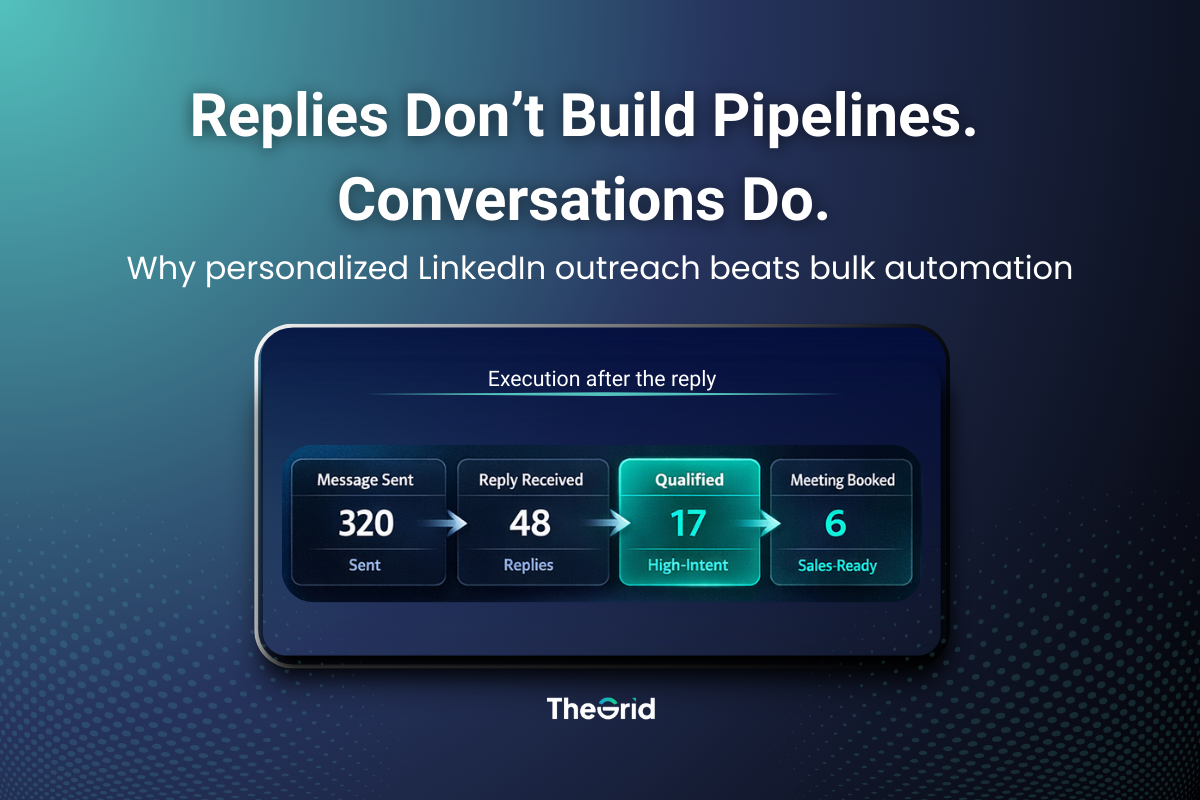
But replies are not conversions. They are invitations to qualify, explore, and guide the conversation forward.
Response Handling Is Where Deals Are Won
When a prospect replies, three things become possible:
- You can understand their real level of intent
- You can adapt your message based on their context
- You can qualify whether a conversation should continue at all
Automation struggles here because responses are unpredictable. Some replies signal curiosity. Others signal timing issues. Many are neutral or exploratory. Handling these moments well requires human judgment.
Manual Qualification: The Step Automation Can’t Replace
Manual qualification doesn’t mean pushing prospects through a rigid checklist. It means actively assessing:
- Are they the right role or decision-maker?
- Is there a real business need or is it just a polite interest?
- Is the timing right for a conversation now?
- Does it make sense to move forward, nurture, or disengage?
This process protects both sides. It prevents sales teams from chasing low-quality meetings. It also prevents buyers from being pushed into conversations they’re not ready for.
High-performing teams treat qualification as a conversation, not a gate.
Why Bulk Automation Fails at Qualification
Automated outreach systems are designed around assumptions:
- If someone replies, they’re interested
- If they accept a connection, they want to talk
- If they don’t respond, follow up again
In reality, B2B buying behavior is far more nuanced. A reply might mean:
- “This sounds interesting, but not now”
- “I’m not the right person”
- “I’m curious, but cautious”
- “I’m researching, not buying”
Without human interpretation, these signals get misread. That’s why automated outreach often results in:
- Low-quality meetings
- Misaligned sales calls
- Friction early in the funnel
Personalized Outreach Enables Adaptive Conversations
When outreach is handled manually or at least guided by humans, teams can respond in ways automation cannot.
Examples include:
- Acknowledging timing concerns instead of forcing a meeting
- Redirecting conversations to the right stakeholder
- Asking clarifying questions before pitching
- Ending conversations early when there’s no fit
This adaptability builds trust, and trust is what keeps conversations moving forward.
The Compounding Effect of Better Response Handling
Strong response handling doesn’t just improve conversion rates. It improves everything downstream:
- Sales calls start warmer and more focused
- Prospects feel understood, not sold to
- Follow-ups become relevant instead of repetitive
- CRM data becomes cleaner and more accurate
Over time, this leads to:
- Shorter sales cycles
- Higher-quality pipelines
- Better alignment between sales and marketing
All without increasing message volume.
Why Fewer Conversations Often Lead to More Revenue
One of the hardest shifts for B2B teams is letting go of volume as a success metric.
Bulk automation feels productive because it’s measurable:
- Messages sent
- Connections added
- Sequences completed
But activity does not equal progress. Teams that focus on:
- Fewer, better conversations
- Intent-based qualification
- Thoughtful response handling
Almost always outperform teams chasing scales for their own sake.
A More Sustainable Model for LinkedIn Outreach
The most effective LinkedIn outreach strategies today share a few principles:
- Automation supports research, not conversations
- Personalization is rooted in relevance, not templates
- Responses are handled by people, not workflows
- Qualification happens before meetings are booked
This model may look slower on the surface. But it’s faster where it matters.
Final Thought: Outreach Is a Conversation, not a Campaign
Bulk automation treats LinkedIn as a broadcast channel. Personalized outreach treats it like what it is: a professional network built on trust, relevance, and timing.
The difference isn’t just how messages are sent. It’s in how responses are handled and how thoughtfully prospects are qualified before the next step.
In modern B2B sales, execution after the reply is what separates noise from momentum.