A playbook for keeping outbound from burning accounts.
Part 1 of 2. This article covers the pre-pipeline gate (before list upload, routing, sequencing)
If you already have open opportunities and need deal freshness + forecast integrity, read Part 2:
Pipeline Decay in SEA: The 90-Day Freshness Checklist → https://sgpgrid.com/article/pipeline-decay-in-southeast-asia-the-90-day-freshness-checklist-for-forecast-accurate-b2b-sales/
KEY TAKEAWAYS
- Outbound performance is capped by list quality. Better copy just helps you reach the wrong people faster.
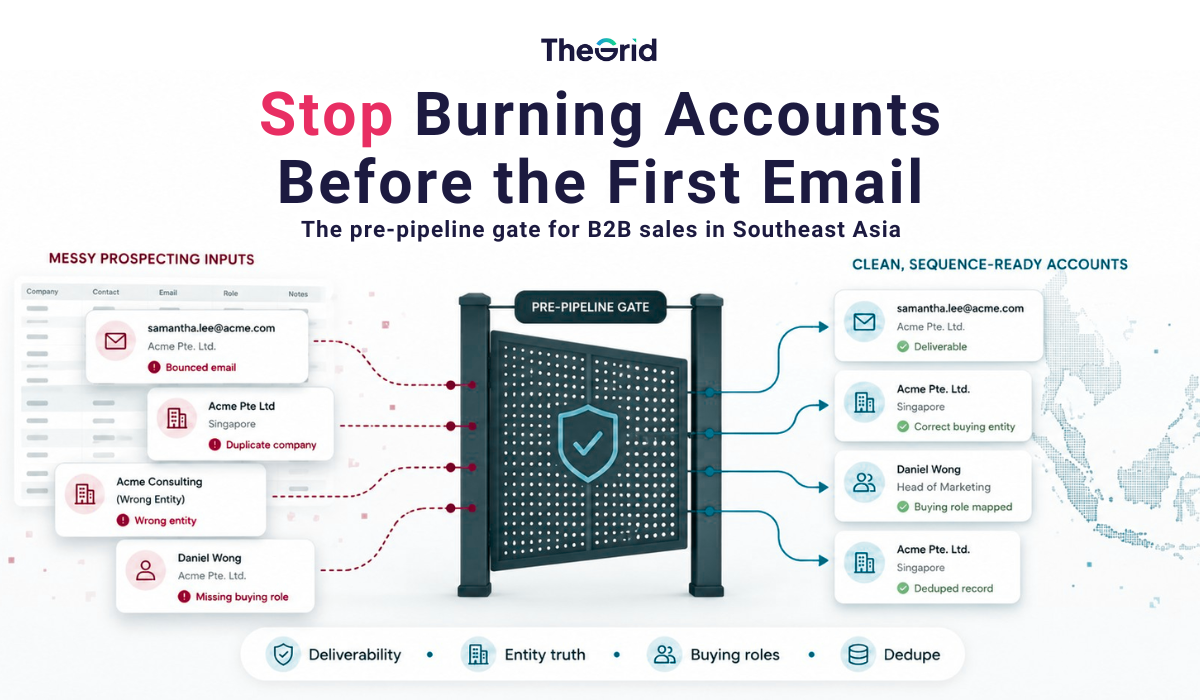
- Run a 10-minute Pre-Pipeline Gate before any list enters a sequence: deliverability, entity truth, buying roles, dedupe.
- The SEA Entity Trap is real: right logo ≠ right buying entity.
- If you can’t pass the gate in 10 minutes, don’t send. Fix first — or burn the account
If your outbound is underperforming in SEA, what should you assume first?
Assume the list is guilty until proven clean.
Most teams try to fix replies with better copy. In SEA, the usual failure is simpler: the input is wrong.
This playbook gives you a 10-minute quality gate to run before any account enters a sequence.
TL;DR: What are we fixing (pre-pipeline)?
Four failures quietly kill SEA outbound:
- Deliverability rot (bounces + dead emails)
- Entity trap (right logo, wrong buying entity)
- Role gaps (contacts exist, buying path doesn’t)
- Duplicates + messy records (routing and attribution rot)
If you do one thing: run the Pre-Pipeline Gate on every list before launch.
What does “burning accounts” look like?
It’s not a failed sequence. It’s a failed input.
A typical week looks like this:
- emails bounce
- replies come from people who left months ago
- “different” accounts are actually subsidiaries under the same group
- the wrong team gets spammed first (and blocks you)
In SEA, this is how good accounts get poisoned before you reach the buyer.
How fast does B2B data go bad?
Fast enough to ruin a quarter.
A commonly cited benchmark is about 2.1% contact decay per month (~22.5% per year) (MarketingSherpa research referenced via HubSpot’s database decay simulator). (Source: HubSpot Database Decay Simulator)
Meaning, 1 in 4 records you trust this year will be wrong next year.
In SEA, decay hurts more because entity structures are messier and changes don’t always surface publicly.
The Pre-Pipeline Gate (10 minutes)
If an account can’t pass this gate, it’s not sequence-ready. Fix first.
1) Company level (entity truth)
- Buying entity confirmed (not just the brand name)
- HQ vs local budget ownership noted
- Group/parent links captured (if relevant)
2) Contact level (real humans, real roles)
- Email deliverability validated (not guessed patterns)
- Current role verified (still employed, still in this scope)
- Assigned to a buying role (see “4-role baseline” below)
3) Ops level (no routing chaos)
- Dedupe + standard fields applied
- Suppression lists applied (bounces, opt-outs, customers)
- Unique identifiers set (person ID, account ID)
Rule: If you can’t pass this gate in 10 minutes, the account is not ready.
The 4 failures (what people ask, and the fix)
1) “Reply rates are flat even with good copy. Why?”
Because you’re emailing ghosts.
Common causes:
- hard bounces accumulate quietly
- role-based inboxes accept but nobody reads
- contacts changed jobs but stayed in your CRM
Fix (minimum deliverability gate):
- Validate deliverability before upload
- Suppress known hard bounces immediately
- Flag/remove role addresses unless intentional
- Dedupe contacts before routing
2) “We keep targeting the right brand but still miss. Why?”
Because brand ≠ buying entity in SEA.
This is the Entity Trap: the logo is right, the buyer is wrong.
SEA entity gate (3 minutes):
- Is it standalone or part of a group?
- Which entity holds budget for your category?
- Is procurement local, regional, or HQ-led?
- Are you contacting the most visible subsidiary, not the approving one?
Rule: No entity truth, no sequence.
Mini-case (common SEA pattern):
A team targets a well-known brand across PH + MY. SDRs sequence local leaders.
But budget + vendor onboarding sit under a regional shared services entity in another country.
Result: activity, no motion.
Fix: one entity check upfront → outreach aimed at the approving entity + onboarding owners.
3) “How do we find decision-makers without boiling the ocean?”
Don’t chase titles. Map buying roles.
Titles vary wildly across SEA. The same title can mean budget owner in one company and implementer in another.
4-role baseline (minimum viable decision map):
- Pain owner (feels the problem daily)
- Process owner (runs the workflow; often champion)
- Budget owner (controls or influences spend)
- Final signer (GM/country head/founder; often invisible)
If you can’t identify all four roles in 15 minutes, design outreach to surface roles, not to “close” immediately.
4) “Routing is messy and attribution is unreliable. Why?”
Duplicates poison ops from the start.
Duplicates show up as:
- the same person in multiple records
- the same company with multiple naming conventions
- two reps emailing the same contact
- reporting that never matches reality
Fix (standardization minimum):
- Standardized company name (legal or consistent standard)
- One website/domain per account
- Country + operating location consistent
- LinkedIn URLs confirmed
- Unique identifier per person record
Rule: Dedupe before load, not after.
Maintenance rhythm (won’t become a side project)
Data hygiene works as a rhythm, not a quarterly panic.
- Weekly: suppress bounces + bad domains from active sequences
- Monthly: refresh high-volume segments + re-verify roles for active lists
- Quarterly: rebuild top outbound accounts from verified sources + re-check entity structure
The quarterly rebuild feels slow. It prevents months of wasted outreach.
Where TheGrid fits (the workflow upgrade)
You can run this playbook manually. The ceiling is consistency at scale.
TheGrid reduces the 3 biggest pre-pipeline time sinks:
- Entity truth: resolve the buying entity behind a brand
- Contact truth: validate reachability + role recency
- Buying path: surface the roles that matter so outreach starts multi-threaded
Result: SDRs spend less time cleaning spreadsheets and more time speaking to the right people. Explore TheGrid → www.sgpgrid.com
FAQ
What is pre-pipeline data hygiene?
A quality gate before outreach that covers deliverability validation, buying entity confirmation, buying role mapping, and standardization with dedupe.
How do I find the right legal entity to target in SEA?
Check if the account is part of a group, confirm which entity owns budget for your category, and identify whether procurement is local, regional, or HQ-led.
How often should I clean my B2B contact list in SEA?
Weekly suppression for bounces, monthly refresh for active segments, and quarterly rebuild for your top outbound accounts.
References:
- HubSpot Database Decay Simulator: https://www.hubspot.com/database-decay
- DemandScience data deprecation guide: https://demandscience.com/resources/blog/b2b-data-deprecation-marketers-guide/
- Gartner B2B buying journey context: https://www.gartner.com/en/sales/insights/b2b-buying-journey