Tagline: A checklist for keeping forecasts honest and deals real.
Part 2 of 2. This article covers open opportunities (stage integrity + forecast integrity).
If you need the pre-sequence data gate (deliverability, entity truth, buying-role baseline), read Part 1:
B2B Data Hygiene in SEA: The Pre-Pipeline Playbook → https://sgpgrid.com/article/b2b-data-hygiene-in-southeast-asia-the-pre-pipeline-playbook-that-stops-outbound-from-burning-accounts-2/
KEY TAKEAWAYS
- Pipeline decay is buying-group drift. Your CRM stage can be accurate and still wrong.
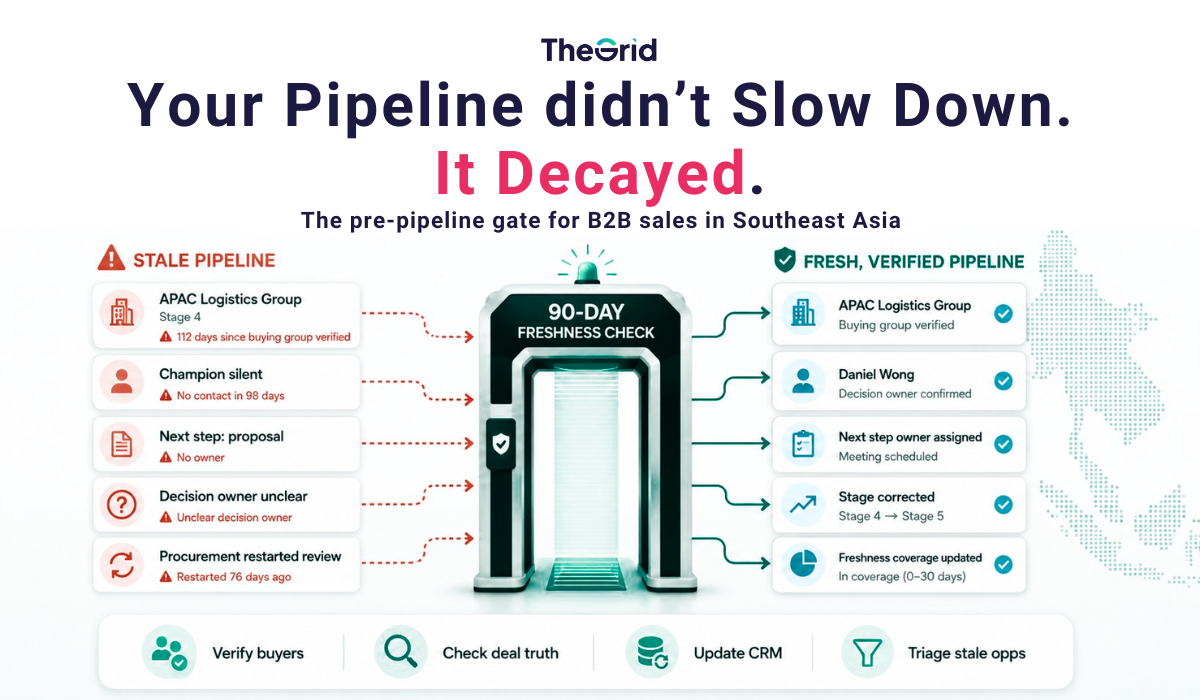
- Use the 90-Day Rule: if the buying group hasn’t been verified in 90 days, the stage is likely inflated.
- Run the 10-minute Freshness Checklist to verify decision ownership, deal truth, and CRM updates.
- Triage stale opps with one action: re-stage, re-qualify, recycle, or close.
- Track Freshness Coverage % (targets: late-stage 80%+, early-stage 60%).
What is pipeline decay?
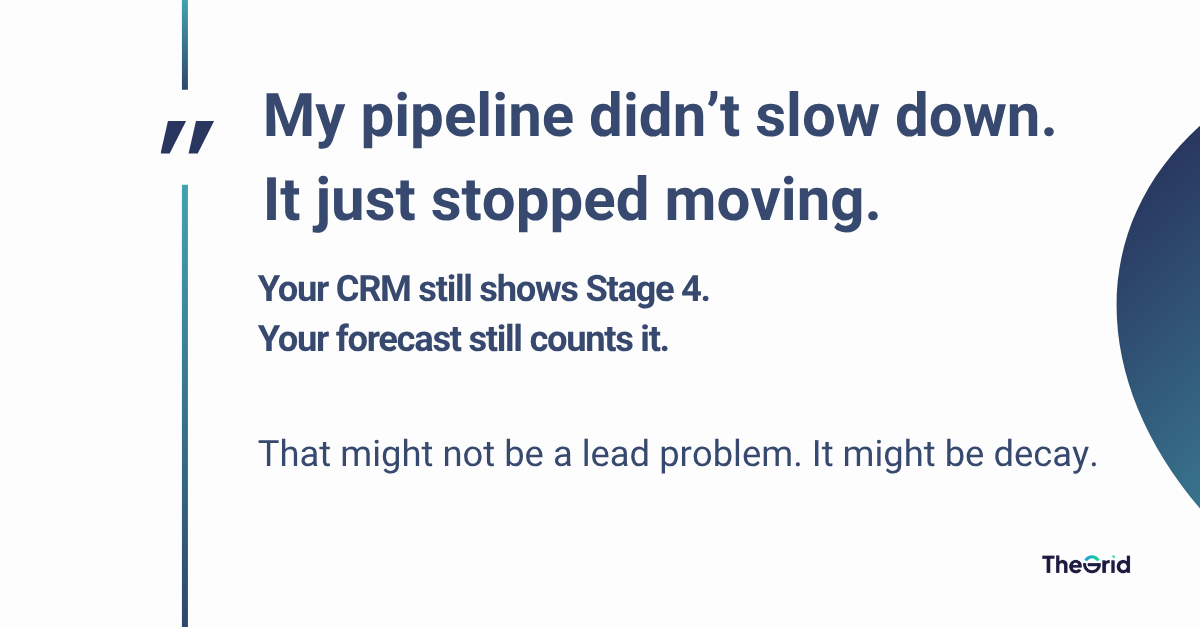
Pipeline decay = an opportunity open in CRM, but the buying reality has shifted.
It usually looks like this:
- champion lost influence
- decision owner changed role or scope
- procurement appeared late and reset requirements
- “next step” exists, but has no owner
- the “why now” no longer applies
The deal isn’t always dead. It’s often just no longer what your CRM says it is.
What is pipeline freshness?
Pipeline freshness = decision ownership is verified and current.
Simple test:
If your CRM can’t show who can say yes today (not who replied first), it’s not a pipeline. It’s a wishlist.
Why this is louder in SEA (one paragraph)
Decision ownership shifts quietly—regional coverage changes, procurement appears late, and priorities reset around quarterly cycles. Your CRM won’t catch this unless someone updates it.
For deeper SEA context on entity mess + data decay, Part 1 covers it.
Why forecast integrity depends on freshness
Bad forecasts don’t come from bad salespeople. They come from bad inputs.
Salesforce notes that forecasting accuracy depends on the quality of the data feeding the forecast. (Source: Salesforce Sales Forecasting Guide)
A Stage 4 deal that hasn’t been updated in 11 weeks is often a Stage 2 deal wearing a Stage 4 label.
Gartner also reports many buyer teams experience unhealthy conflict during decision-making (Source: Gartner press release, 2025) —meaning the buying group can shift or fracture without warning.
If you’re not verifying who’s driving the decision now, you’re forecasting on old reality.
The 90-Day Rule
Not because everyone changes jobs every quarter. Because approval paths shift on quarterly cycles.
Budget rechecks happen quarterly. Priorities reshuffle quarterly. Review gates appear quarterly.
Rule: If you haven’t re-verified the buying group in 90 days, your stage is probably inflated.
High-velocity deals: 30–60 days.
Enterprise: still check at 90.
The 90-Day Freshness Checklist (10 minutes per opportunity)
Run this on:
- every opportunity open >30 days
- every active deal at least once every 90 days
- immediately after a major account signal
Step 1: “Who can say yes today?” (5 minutes)
Name the person, not the title.
- Who approves today? (name them)
- Is the champion still active and influential?
- Who can block? (procurement/finance/security/HQ)
- Who else must be in the room?
- Does the next step have a named owner + date?
If you can’t answer #1 with a name, stop. Re-map the buying group.
Step 2: “Is the deal still true?” (3 minutes)
Truth beats optimism.
- What changed since the last meaningful conversation?
- Is the “why now” still real?
- Can you describe the yes-path? (reviews, approvals, order)
If you can’t describe the yes-path plainly, the deal is not at the stage your CRM claims.
Step 3: “What do we update in CRM?” (2 minutes)
Update what changes truth.
- Tag contacts by role: decision owner / champion / blocker / influencer
- Set Buying Group Last Verified = today
- Set Next Step Owner = a named person
If you can’t complete this in 10 minutes, your stage is likely inflated.
What signals mean the buying group drifted?
If any of these happen, refresh within 48 hours.
1) People signals
Role changes, new leaders, org reshuffles.
Action: re-map decision owner + champion fast.
2) Finance/procurement signals
New review gates mid-evaluation. Procurement appears late. Budget shifts.
Action: update approval path + identify blockers earlier.
3) Org/structure signals
Regional ownership changes. Re-orgs. New business lines.
Action: confirm where authority sits now (country vs regional vs HQ).
One-liner: Signals beat memory.
What do we actually do with stale opportunities?
Stop labeling “At Risk.” Choose one action.
Mark an opp STALE if any one is true
- buying group not verified in 90 days
- champion unresponsive + no secondary thread
- major signal occurred but CRM wasn’t updated
- next step has no owner
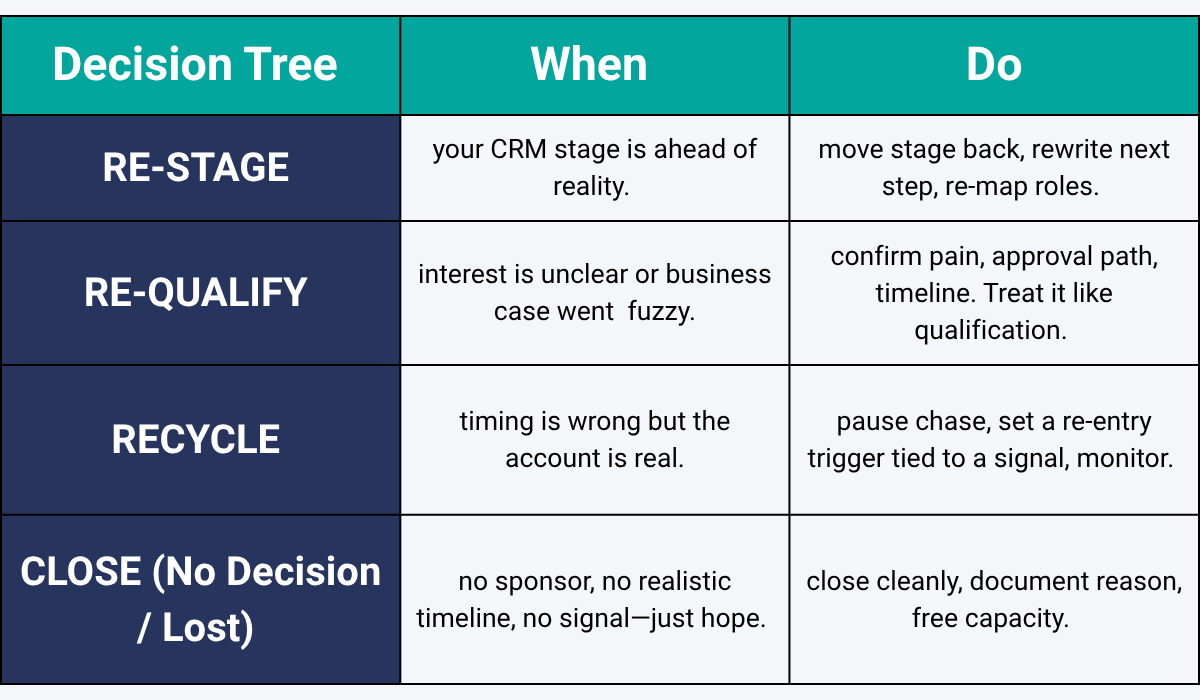
Decision tree: pick ONE action
- RE-STAGE if reality < CRM stage
- RE-QUALIFY if the business case is fuzzy
- RECYCLE if timing is wrong but the account is real
- CLOSE if there’s no sponsor, no timeline, no signal
The one metric to start tracking
Freshness coverage.
Ask:
What % of pipeline has Buying Group Last Verified within the last 90 days?
Starting targets:
- late-stage: 80%+
- early-stage: 60%+
If late-stage is below 80% fresh, your forecast isn’t trustworthy—regardless of stage labels.
Where TheGrid fits (the non-manual upgrade)
A disciplined team can run this manually. The ceiling is visibility, especially in SEA.
TheGrid makes freshness a workflow, not a hero effort:
- detects decision-maker movement + people changes
- Tracks finance injections and spending power
Result: less stage inflation, cleaner pipeline reviews, forecasts based on current decision ownership—not hope.
See how signal alerts work → https://sgpgrid.com/
FAQ
What is pipeline decay in B2B sales?
When an opportunity stays open in CRM but buying reality has shifted (decision owner, champion influence, procurement gates, or urgency).
How do I know if my pipeline is stale?
If buying group hasn’t been verified in 90 days, champion is unresponsive without a second thread, a major signal occurred without CRM updates, or the next step has no owner.
What should I do with stale opportunities?
Choose one: re-stage, re-qualify, recycle, or close—based on reality, not hope.
References
- Salesforce Sales Forecasting Guide: https://www.salesforce.com/ap/sales/analytics/sales-forecasting-guide/
- Gartner buyer-team conflict press release: https://www.gartner.com/en/newsroom/press-releases/2025-05-07-gartner-sales-survey-finds-74-percent-of-b2b-buyer-teams-demonstrate-unhealthy-conflict-during-the-decision-process
- Gartner B2B buying journey context: https://www.gartner.com/en/sales/insights/b2b-buying-journey