If you’re a founder, sales manager, or SME owner, you’ve probably hit the same painful moment:
Your outreach stalls.
Your emails stop sending.
Your account freezes with a 24-hour block.
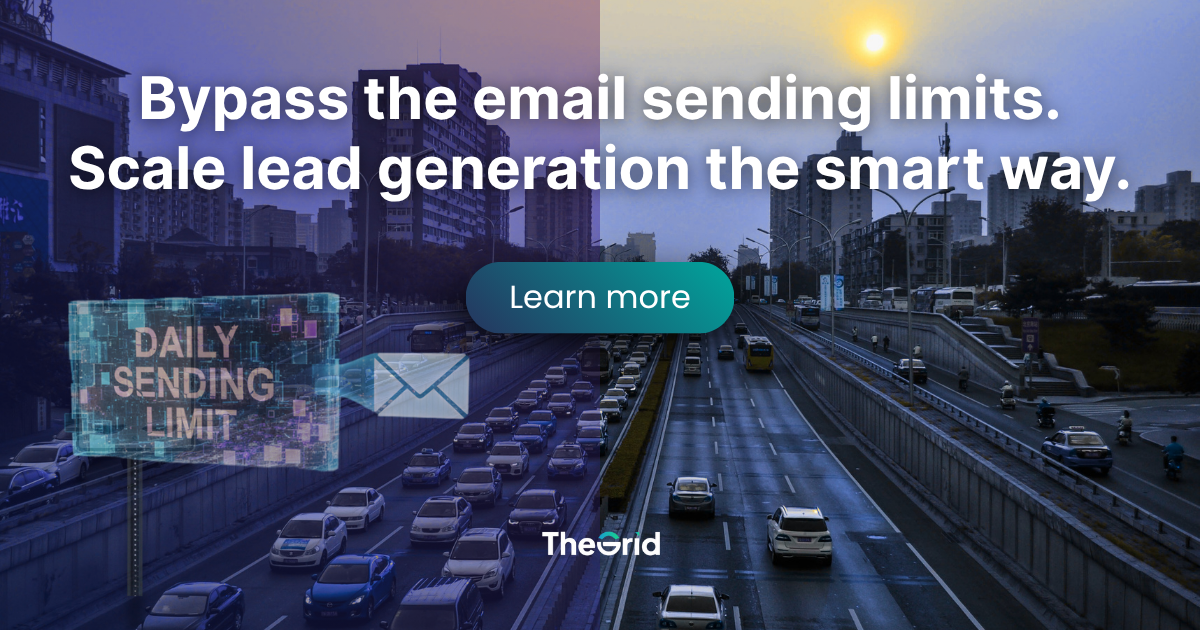
You’ve officially crossed your email sending limits—and your growth engine goes from fifth gear to a full stop.
Most people blame Gmail or Outlook for slowing them down.
But here’s the truth:
Your sending limits aren’t the real problem. Your sender reputation is.
Google and Microsoft aren’t punishing you. They’re protecting the inbox from spam—and they’re warning you to do the same.
If you want scalable, sustainable, high-converting B2B outreach, you must stop fighting the limits and start using them as strategic signals.
This guide will show you the mindset shift and system you need to turn email limits into an advantage—and scale your lead generation the smart, compliant, and ROI-driven way.
1. Stop Obsessing Over Sending Caps—Start Fearing the Penalties
Here’s what founders usually think about:
- Gmail limit: 500/day
- Google Workspace: 2,000/day
- Outlook.com: ~300/day
- Microsoft 365: 10,000 recipients/day
These numbers look impressive.
But focusing on them is the reason most outreach fails.
These are what we call:
Vanity Caps — the numbers that don’t matter.
Why? Because your account will get throttled, blocked, or flagged long before you ever reach the official limits.
The real limit is not how many emails you can send.
It’s how many emails you can send without damaging your account health.
Because the moment your sender reputation dips—
Google, Microsoft, and every major provider instantly flip the kill switch.
A 24-hour block isn’t just inconvenient—it can collapse early-stage sales momentum.
2. The Real Threat: Why a 0.1% Spam Rate Can Destroy Your Domain
While you obsess over volume, email providers obsess over complaint rate.
And their tolerance is microscopic.
According to Google Postmaster Tools:
**You must maintain a spam complaint rate below 0.1%.
At 0.3%, you're considered a spammer.**
Let’s put that into perspective:
- Send 1,000 emails → You can afford one complaint.
- Send 100 emails → One complaint = 1.0% (10× over the danger zone).
- Send 2 complaints → Welcome to the spam folder forever.
One wrong target can poison your entire domain.
This is why “spray and pray” cold outreach is no longer a strategy—it’s digital self-sabotage.
For founders scaling into new markets, your spam complaint rate is the single metric that determines whether your emails land, get ignored, or disappear into spam purgatory.
3. The Deliverability Blueprint: The Only 3 Pillars That Actually Scale
A great cold email strategy today isn’t about volume—it’s about reliability, reputation, and relevance.
To scale B2B lead generation in 2025, you need these three pillars:
Pillar 1: Warm Up Your Domain Like a Pro (Not a Spammer)
Sending high volume from a new domain looks suspicious.
Email providers immediately assume:
- Spammer
- Bot
- Hacked account
The fix?
Implement a slow, controlled domain warm-up:
- Start with 10–20 emails/day
- Send only to highly engaged contacts
- Gradually scale over weeks
- Build positive signals (opens, replies, engagements)
This alone can prevent 80% of deliverability failures.
Pillar 2: Authenticate Your Domain (SPF, DKIM, DMARC)
Without authentication, your email is a stranger knocking on inboxes.
With authentication, you’re verified—trusted—welcome.
Set up all three:
- SPF → “This server is allowed to send for my domain”
- DKIM → “This message hasn’t been tampered with”
- DMARC → “If something looks wrong, follow my rules”
Missing even one can cause:
- Throttling
- Bounces
- Inbox rejections
A properly authenticated domain gets fast-tracked to the inbox.
Pillar 3: Personalization Is Now a Deliverability Signal
Personalization isn’t just a sales tactic—it’s a trust signal.
Providers measure:
- replies
- engagement
- scroll depth
- positive user actions
The more personalized your email, the more likely it is to receive an interaction that protects your sender reputation.
In practical terms:
**Personalized = inbox.
Generic = spam.**
For outreach in Tech, Fintech, SaaS, Manufacturing, and Logistics, this means:
- reference real pain points
- mention relevant metrics
- talk to the industry’s problems
- write like a human, not a template
This drastically reduces complaint rates and increases deliverability.
4. Why Founders Fail: The Tug-of-War Between Speed & Safety
Every growing business faces the same dilemma:
- You need a full pipeline.
- But you can’t afford to destroy your domain.
- And your Gmail/Outlook inbox was not designed for bulk B2B outreach.
If you're trying to scale with a traditional email inbox, one of these will eventually happen:
→ Your domain gets throttled
→ Your emails go to spam
→ Your daily limit is slashed
→ Your account gets blocked
This is why real B2B lead generation needs more than a mailbox.
It needs an infrastructure.
5. Scaling Beyond Limits: Why High-ROI Lead Generation Requires More Than Gmail or Outlook
To win in 2025 and beyond, you need:
✓ domain warm-up automation
✓ complaint rate monitoring
✓ inbox rotation to avoid throttling
✓ compliance with anti-spam rules
✓ verified, accurate B2B leads (this is critical)
✓ a system that protects your domain health 24/7
Your team shouldn’t be babysitting email deliverability.
You should be closing deals.
This is where The Grid becomes the strategic advantage.
The Grid: Your Compliant, High-Deliverability B2B Lead Generation Engine
The Grid doesn’t just send emails.
It builds a complete outbound engine that:
- stays compliant with Google & Microsoft guardrails
- protects your sender reputation
- automates email warm-up
- ensures your sending volume is safe
- delivers hyper-targeted, high-intent B2B leads across Southeast Asia
- maximizes deliverability and reply rates
- eliminates low-quality contacts that cause spam complaints
If you want to scale B2B outreach without ever worrying about:
- Sending limits
- Throttling
- Domain damage
- Wasted email
- Slow-quality leads
—then it’s time for the right infrastructure.
Stop Playing the Sending-Limits Game. Start Scaling Responsibly.
Stop risking your domain.
Stop burning your sender reputation.
Stop blasting cold emails that cost you more than they convert.
Let’s build you a compliant, high-ROI, automated B2B lead generation engine that scales safely—without ever touching the danger zone.
Book a strategy call with The Grid today.
Because the problem isn’t your sending limit.
The problem is your strategy—and we’ll fix that.
References
The data and strategic thresholds cited in this article are derived from official provider documentation and recognized industry standards in email deliverability and cold outreach:
- Google Workspace & Gmail Sending Limits: Official limits for free and paid accounts, plus rules on account suspension and message recipient caps. (Source: Google Support)
- Google Postmaster Guidelines: The mandatory requirement to maintain a spam complaint rate below 0.1% to ensure healthy deliverability, as well as necessary authentication standards (SPF/DKIM/DMARC). (Source: Google Support)
- Microsoft Outlook/365 Sending Limits: Official recipient limits for both free Outlook.com and paid Microsoft 365 accounts (up to 10,000 recipients/day). (Source: Microsoft Learn & Support)
- Industry Deliverability Best Practices: Expert advice on sustainable cold email volume (often cited as <30/day), domain warm-up strategies, and the importance of engagement metrics over raw send volume. (Sources: Allegrow, Salesforge, Warmup Inbox, EmailToolTester)