TL;DR
Yes, AI works for B2B sales in Southeast Asia and ANZ. But it only works as well as the account context underneath it. AI can draft outreach, score accounts, summarize calls, and reduce admin. What it cannot do is fix a stale list, guess the real buying path, or invent accurate company context from weak inputs. In SEA and ANZ, the risk is not that AI writes badly. It is that AI writes confidently from data your team should have questioned first.
The short version:
· AI is a multiplier, not a source of truth.
· Multiply good data, and you get leverage. Multiply bad data, and you get faster failure.
· In SEA and ANZ, the data layer is the bottleneck, not the AI.
The question everyone is actually asking
AI is not failing in Southeast Asia or ANZ because it cannot write. It is failing because it is writing from account context your team never verified.
The pitch is everywhere: AI SDRs that prospect for you, AI writers that personalize a thousand emails, AI enrichment that automatically fills your CRM.
So teams buy the tools. A few months in, the quiet question surfaces in leadership meetings across Singapore, Kuala Lumpur, and Melbourne: is this actually working?
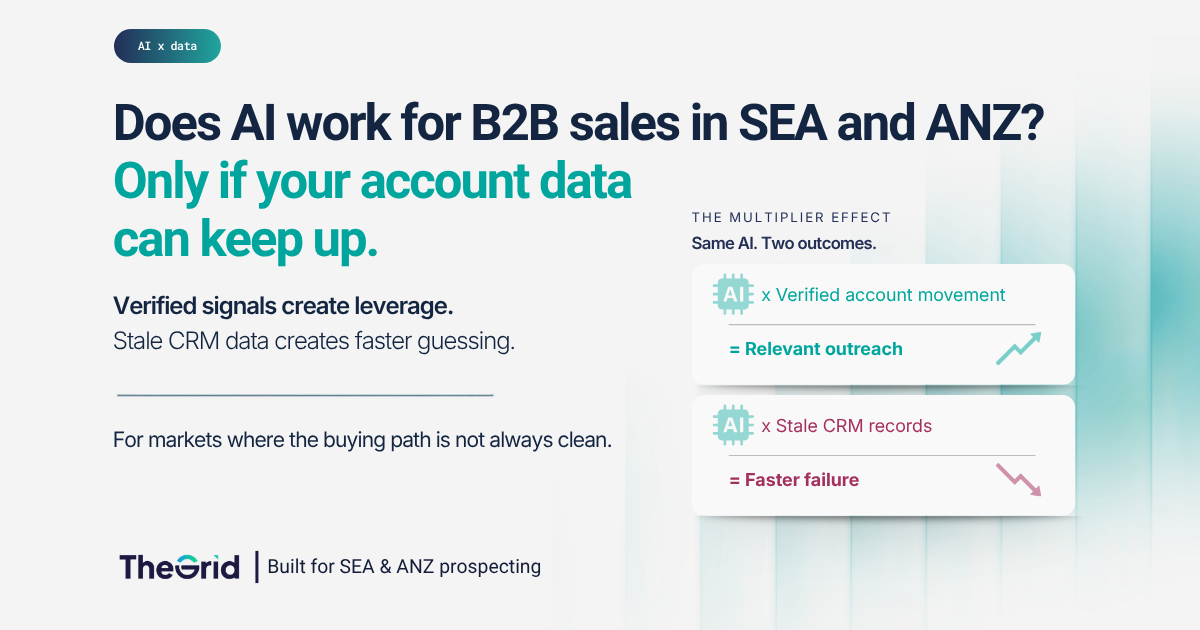
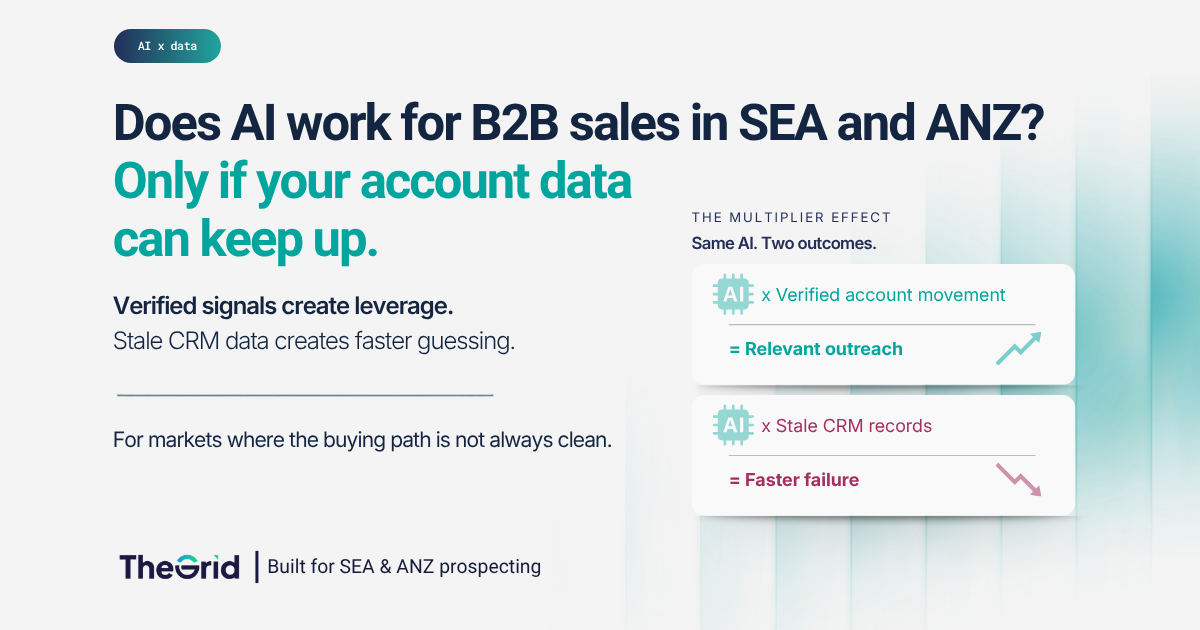
The honest answer is not a yes or a no. It is a condition. AI works for B2B sales in Southeast Asia and ANZ when the underlying data is accurate and up to date. When it is not, AI does not fix your sales problem; it accelerates it.
What AI genuinely does well in sales
Used on solid data, AI is a real advantage. It is very good at:
· Drafting and personalizing outreach at scale, so reps spend less time on a blank message.
· Summarizing discovery calls and pulling out the action items and next steps.
· Scoring and ranking accounts against your ICP so reps know where to look first.
· Automating repetitive admin, from logging activity to updating fields and drafting follow-ups.
· Spotting patterns across large sets of accounts that a human would miss.
Notice the common thread: each one takes something that already exists and makes it faster or sharper. AI is a multiplier. It does not create truth; it operates on the truth you give it.
AI is not failing your SEA/ANZ sales team. Your account context is.
AI is getting blamed for the wrong problem.
When an AI sales tool sends a polished email to the wrong person, the issue is not the writing.
When it scores a dead account as high priority, the issue is not the model.
When it personalizes outreach around a title that changed months ago, the issue is not the prompt.
The issue is the account context underneath it.
That is the uncomfortable part for B2B teams in Southeast Asia.
AI makes the workflow faster. It does not make the market clearer.
And in this region, clarity is usually where the real sales problem sits.
The company may exist, but the local entity may be wrong. The contact may look senior, but not own the decision. The person replying may be researching, not approving. The budget may sit with finance, procurement, leadership, or regional HQ. The account may look active in your CRM while the market has already moved on.
In ANZ, the risk looks slightly different. Buyers may enter the conversation already self-educated. They may have compared tools, checked integrations, read proof, and formed a shortlist before your rep appears. If your AI is working from stale account context, your outreach does not sound efficient.
It sounds late. That is why AI can look impressive in a demo and still underperform in a territory.
The demo has clean inputs. Your CRM has January’s list, duplicate entities, contacts who moved, and one “decision-maker” who was never the decision-maker.
AI will not question that for you. It will work with it. Fast.
Wrong message? Maybe not. Wrong context? Very possible. Perfect grammar. Weak account visibility.
That is how teams scale guessing and call it a pipeline.
This is not just a sales-team complaint.
Salesforce’s State of Sales ASEAN found that 32% of Singapore sales professionals cite incomplete or inaccurate data as a reason their organizations are not yet using AI agents. Another 64% say disconnected systems are slowing AI initiatives, and 85% are focusing on data cleansing.
In other words, AI adoption is not being blocked only by model quality.
It is being blocked by data quality. And in Southeast Asia and ANZ, data quality is not just an email-validity problem.
It is an account-context problem.
The company may exist. The title may look right. The CRM field may be filled. The sequence may be ready.
But if the buying path is wrong, AI only helps your team move faster in the wrong direction.
A simple scenario: the same tool, two outcomes
Picture two teams in Singapore running the identical AI outreach tool.
Team A points it at a global contact list they exported in January. The AI writes beautifully and sends 3,000 personalized emails in a week. The problem: a chunk of the titles have changed, several companies have restructured, and a handful of the businesses have quietly closed. Reply rate craters, a few prospects flag the emails as irrelevant, and inbox providers start throttling the domain. The tool did its job. The list did not.
Team B feeds the same tool verified, current data, and a shortlist of accounts showing real movement, such as recent hiring or a leadership change. The AI sends far fewer emails, but each one lands with the right person at a moment that makes sense. Same software, same week, opposite result. The only variable that changed was the data.
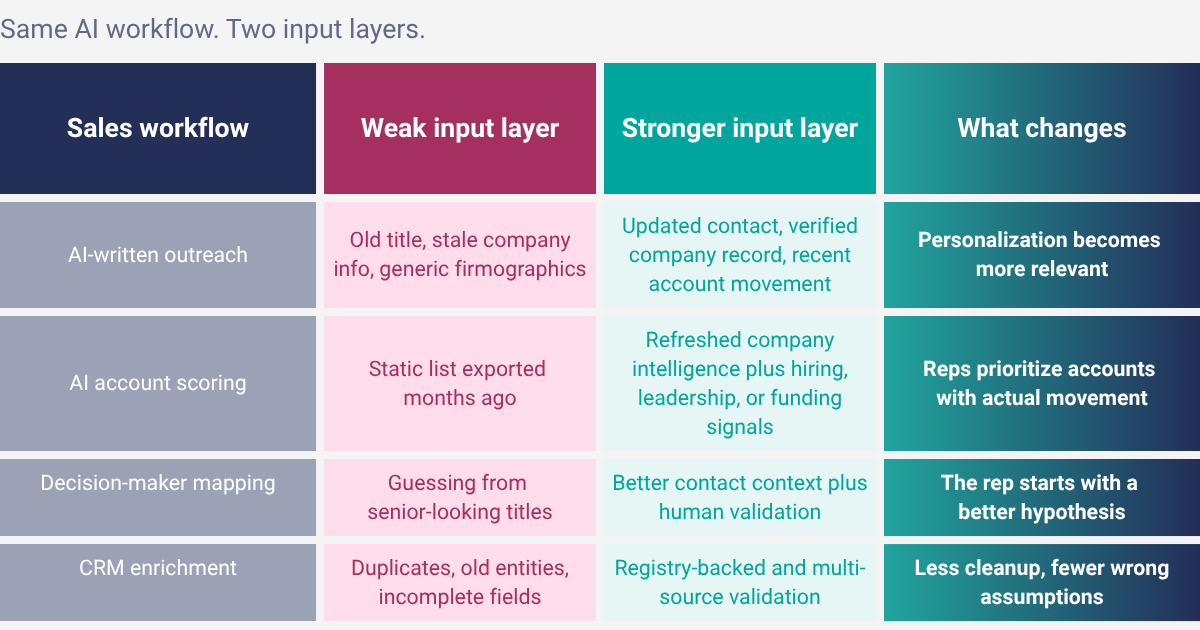
AI output using stale/global data vs AI output using verified, refreshed, local account context
So the difference is not whether the AI can generate output. It is what kind of account reality the output is built on.
How to make AI actually work for SEA and ANZ sales
If you want AI to earn its cost in this region, work in this order:
- Fix the data layer first. Before you automate anything, make sure the accounts, entities, and contacts you feed the AI are verified and current for SEA and ANZ specifically. Everything AI does downstream inherits the quality of this layer.
- Let AI handle the volume work, not the judgment work. Use AI for drafting, summarizing, ranking, and admin. Keep human judgment on the regional calls: who the real buyer is, whether the timing is right, how to navigate a relationship-led deal. AI proposes; the operator decides.
- Feed AI real signals, not just static profiles. AI scoring a frozen list only re-ranks the past. Feed it live movement, such as hiring changes, leadership moves, and funding, and its prioritization starts reflecting who is in motion now.
- Measure output quality, not just output volume. It is easy to celebrate that AI sent 5,000 emails. Ask the harder question: how many reached the right person, at a real moment, and earned a reply? Relevant volume is the only volume that counts.
Where TheGrid fits
TheGrid is not here to replace AI tools or seller judgment.
It strengthens the account intelligence layer those workflows depend on.
For teams prospecting across Southeast Asia and ANZ, TheGrid helps provide richer company intelligence, contact enrichment, verified company records, and account movement signals, so reps are not building AI-assisted outreach from static lists alone.
That matters because AI can only work with the context it is given.
If the account record is stale, the output gets riskier. If the contact is wrong, the personalization gets wasted. If the buying signal is missing, the timing becomes guesswork.
The goal is not more automation for its own sake.
The goal is better context before automation.
Because in this region, speed without account visibility does not create smarter prospecting.
It just creates faster guessing.
FAQs
Does AI really work for B2B sales?
Yes, when it runs on accurate, current data. AI is excellent at drafting outreach, summarizing calls, scoring accounts, and automating admin. It cannot compensate for stale or incomplete data; it can only act on what it is given, faster.
Why do AI sales tools underperform in Southeast Asia?
Many AI sales workflows still rely on global contact and company databases that are stronger in mature, English-first markets than in fragmented regional markets. Research widely cited by HubSpot puts contact data decay at around 2.1% per month. When the underlying data is stale or points to the wrong decision-maker, AI scales those errors at speed. The tool is not the problem; the data foundation is.
How do you make AI trustworthy for SEA and ANZ sales data?
Start by improving the account context before you automate. AI-assisted prospecting works better when verified company records, cleaner contact data, and account movement signals support it. TheGrid helps teams strengthen that layer across Southeast Asia and ANZ, so reps are not building outreach from static lists alone.
The point is not to replace seller judgment. It is to give AI and sales teams cleaner context before outreach.
Can AI find decision-makers in SEA companies?
Only as well as its data allows.
AI can help suggest likely stakeholders, enrich contact records, and identify patterns. But in Southeast Asia, titles do not always reveal influence. The person replying may be researching, the approver may sit in finance or regional HQ, and the person blocking the deal may never appear in the first call.
Verified company and contact data can make decision-maker discovery more grounded.
It does not replace human validation.
The honest bottom line
AI is not magic, and it is not a gimmick. It is a multiplier. In Southeast Asia, the deciding factor is not which AI tool you pick; it is whether the data underneath it can be trusted. Fix that, and AI becomes the advantage everyone is promising. Skip it, and you are just making the same mistakes faster.
Want to give your AI stack a foundation it can actually trust? See how TheGrid helps sales teams build AI-assisted prospecting on cleaner company, contact, and account intelligence across Southeast Asia and ANZ.
Sources
Salesforce, State of Sales 2026: The 4 Biggest Takeaways for ASEAN Sellers
DemandScience, The Marketer’s Guide to B2B Data Deprecation
IndustrySelect, Measuring the High Cost of Bad Contact Data
Forbes Business Council, The B2B Data Decay Epidemic
ACRA, Accounting and Corporate Regulatory Authority
Related Reading
Outbound Sales in SEA: The Real Reason You are Getting No Replies
Coach Signals, Not Call Counts: 3 Questions for SEA Sales Leaders