You rewrote the sequence. Again.
Shorter emails. Stronger hooks. “Personalized” openers that are 80% Mad Libs.
And still... silence.
Here’s the uncomfortable truth: your messaging probably isn’t the problem.
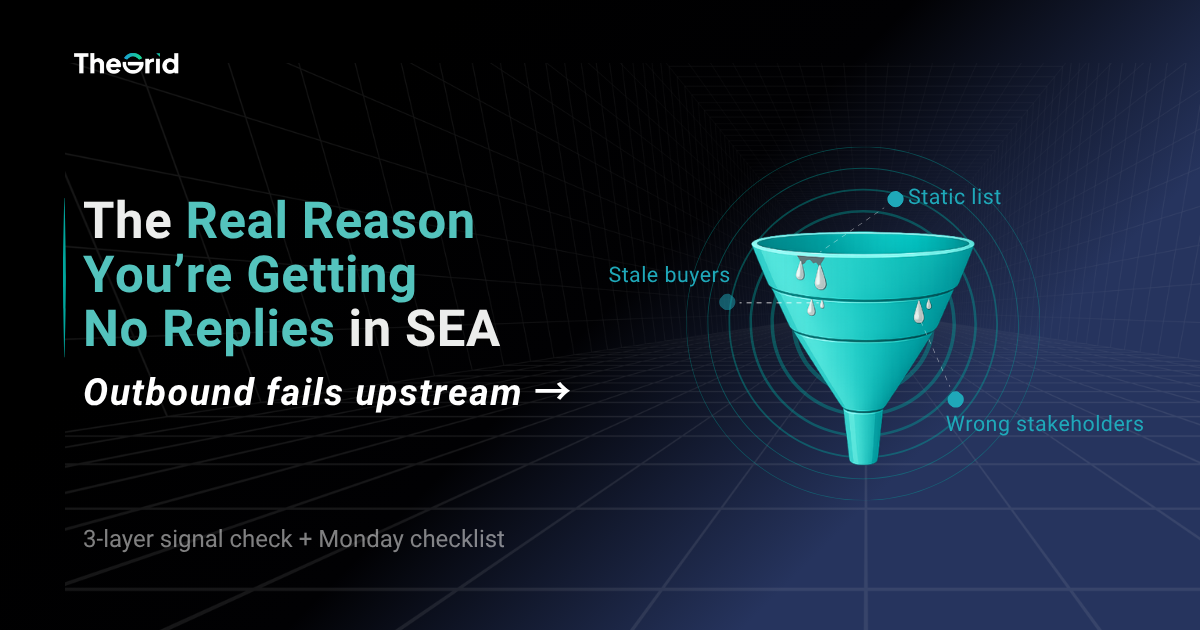
In Southeast Asia, outbound usually breaks upstream before a single email gets sent.
Promise (read this before you tweak another subject line)
In this post, you’ll learn why SEA outbound breaks upstream, the 3-layer signal check to fix it, and the 3 most reliable buying triggers we see across the region.
The illusion of an “active” pipeline
Most pipelines look healthy because activity is easy to measure.
Reality is messier:
- Contacts move. Titles change. Email addresses die.
- The “decision-maker” in your CRM is often a door not the buyer.
- Most accounts aren’t in-market when you reach them, so your outreach becomes background noise.
SEA amplifies this because org visibility is patchy, buying committees are layered, and updates don’t always show up neatly in global databases.
Proof block #1: your contact list is decaying right now
Marketing Sherpa research (commonly cited by HubSpot and others) puts B2B contact data decay at ~2.1% per month, which annualizes to ~22.5% per year — meaning roughly 1 in 4 records can go stale within 12 months if you’re not refreshing continuously.
- HubSpot reference: https://www.hubspot.com/database-decay
- DemandScience reference: https://demandscience.com/resources/blog/b2b-data-deprecation-marketers-guide/
- IndustrySelect reference: https://www.industryselect.com/blog/measuring-the-high-cost-of-bad-contact-data
And some sources citing Gartner suggest decay can be much higher in certain contexts (often quoted as “as fast as ~70%+ annually”), depending on market and dataset.
Rates vary by industry and database; the point is that contact data decays continuously, and SEA teams feel it more because org visibility is patchier.
- Forbes (citing Gartner): https://www.forbes.com/councils/forbesbusinesscouncil/2024/04/18/the-b2b-data-decay-epidemic-how-to-protect-your-bottom-line/
Translation: your team isn’t “bad at outbound.” They’re often working a list that’s quietly turning into a graveyard.
Why SEA outbound is a different beast
Global outbound playbooks assume the market will do you a favor: clean org charts, obvious buyers, and public buying signals.
SEA rarely plays that way.
- Org charts are fuzzy (or functionally fictional).
In Jakarta, a “Head of ____” title can look senior on LinkedIn… while budget sits elsewhere (founder, family, regional HQ, or a different function entirely). - Decision-making is layered — and relationship-gated.
In Manila, you can email the “right title” and still go nowhere if the internal sponsor (often ops/finance/procurement) isn’t aligned — or if entry needs relationship trust first. - Company changes happen quietly — then show up late.
In Kuala Lumpur, expansions, entity updates, and vendor changes can happen without fanfare. If you rely on public headlines, you’re usually late.
So you can have great messaging and still lose — because you’re targeting the wrong person, at the wrong time, with no defensible reason why now.
The real breakdown: timing + signal (not copy)
Most outbound teams optimize effort metrics: emails sent, calls made, sequences completed.
But effort without signal is just noise.
In SEA, replies are driven less by clever phrasing and more by one thing:
context + timing.
When you reach out as a company enters motion, you’re not interrupting — you’re aligning.
Want a deeper take on the “signals > vibes” idea?
- https://sgpgrid.com/article/your-b2b-pipeline-isnt-unpredictable-youre-just-looking-at-the-wrong-signals/
- https://sgpgrid.com/article/inbound-vs-outbound-lead-generation-what-works-best-for-smes-in-sea/
How to improve outbound reply rates in SEA
If your outbound reply rate is flatlining in Southeast Asia, stop tuning copy and fix the upstream mechanics:
- Start with companies in motion, not static lists. Prioritize accounts showing real-world movement so you’re not interrupting cold accounts.
- Map the buyer reality (not the org chart). Identify the economic buyer and one hidden stakeholder (ops/procurement/IT/finance) who can block you.
- Attach one trigger per account. No trigger = no sequence. Your first line should answer “why now?” without sounding robotic.
- Sequence only when timing is defensible. If you can’t explain why this quarter in one sentence, you’re not building a pipeline... you’re burning touches.
A practical framework: the 3-layer signal check
Before any account enters your outbound sequence, run it through this.
Layer 1: Is the company actually in motion?
You’re not looking for “interest.” You’re looking for change, the kind that creates budget, urgency, or operational pain.
Use this rule: If you can’t point to a concrete company-level trigger, don’t sequence the account yet.
Signal categories + what they look like (aligned to TheGrid alerts)
1) Business information update
Core business details changed (address/registration/key company info). Often tied to moves, restructures, new sites, or admin refresh that precedes operational shifts.
What to write (1 sentence):
“Noticed your business details were recently updated. Is this linked to an operational change you’re standardizing this quarter?”
2) Financials
Fresh funding/capital injection that kicks off a “move faster” period: headcount, tooling, vendor reviews, process upgrades.
What to write (1 sentence):
“Saw the recent capital injection, when teams enter growth mode, ___ becomes a bottleneck fast; are you evaluating options to support scale this quarter?”
3) Human capital
Leadership changes and/or hiring ramps, the closest thing to an evaluation window. New leaders bring mandates; hiring exposes workflow gaps.
What to write (1 sentence):
“Noticed the leadership/hiring changes. When teams ramp like this, they usually revisit ___; is improving that on the roadmap for the next 60–90 days?”
Layer 2: Do you have the right people?
In SEA, “decision-maker” is rarely one person. You need two:
- Economic buyer: who owns budget / signs off
- Hidden stakeholder: who can quietly block you (ops, procurement, IT, finance)
Quick checks:
- Has the contact changed roles in the last 6–12 months?
- Are you emailing an owner/budget-holder… or an implementer?
- Who controls vendor onboarding?
Layer 3: Is the timing defensible?
This is the simplest test and the most ignored:
If you can’t explain why now in one sentence, don’t sequence the account yet.
The 3 most reliable buying triggers in SEA (the ones that actually earn replies)
Forget “intent signals” that require mind-reading. In SEA, the best triggers are tied to real operational change, the kind that creates urgency inside a company.
1) Business information update: the company is changing shape
When a company updates core details (address, registration info, key company records), it’s rarely admin housekeeping. It often signals a move, restructure, new site, or operational shift, which is when processes break and vendors get reconsidered.
What to write (1 sentence):
“Noticed your business details were recently updated — is this tied to an operational change (new site/team/process) you’re standardizing this quarter?”
2) Financials: new money creates a short window of urgency
Fresh funding doesn’t just add runway, it adds expectations. Targets rise, timelines compress, and leadership starts asking “why are we still doing this manually?” This is when buyers are most open to conversations that help them scale faster or tighten control.
What to write (1 sentence):
“Saw the recent capital injection, when teams enter growth mode, ___ becomes a bottleneck fast; are you evaluating options to support scale this quarter?”
3) Human capital: leadership and hiring ramps trigger reviews
New leadership appointments and hiring surges are the closest thing to an evaluation window. New leaders arrive with mandates. Hiring ramps expose process gaps. Either way, teams revisit tools, workflows, vendors, and reporting.
What to write (1 sentence):
“Noticed the leadership/hiring changes, when teams ramp like this, they usually revisit ___; is improving that on the roadmap for the next 60–90 days?”
Proof block #2: titles change faster than your CRM refresh cycle
LinkedIn reports that professionals entering the workforce today are on pace to hold twice as many jobs over their careers compared to 15 years ago, and that more than 10% of professionals hired today have job titles that didn’t exist in 2000.
- LinkedIn research page: https://economicgraph.linkedin.com/research/work-change-report
- Direct PDF: https://economicgraph.linkedin.com/content/dam/me/economicgraph/en-us/PDF/Work-Change-Report.pdf
Translation: if you treat your buyer list like a static asset, it will betray you.
What to do Monday morning (a mini checklist your team will actually use)
- Clean your top 50 accounts for job changes
Confirm the buyer still exists in-role. Validate email + title. - Identify the economic buyer + 1 hidden stakeholder
Who signs? Who blocks? (procurement/ops/IT/finance) - Attach 1 trigger per account
No trigger = no sequence. - Only sequence accounts with defensible timing
If “why now” isn’t obvious, it’s not pipeline — it’s wishful thinking.
Here’s what signal discovery looks like in practice
Most teams start with a static list and hope activity creates outcomes.
Signal-led teams start with companies in motion, then map the buyer, then write outreach that earns attention because it’s anchored to something real that changed.
Here’s an anonymized example of the kind of alert-driven signal pack teams use for SEA prospecting:
Sample signal pack (anonymized)
- Business information update: “Company updated core business details (address/registration/contact records).”
Outreach angle:
“Noticed your business details were updated, is this linked to an operational change you’re standardizing this quarter?” - Financials: “Company received fresh funding/capital injection.”
Outreach angle:
“Saw the capital injection, when teams enter growth mode, ___ becomes a bottleneck fast; are you evaluating options to support scale this quarter?” - Human capital: “New leadership appointment and/or department hiring ramp detected.”
Outreach angle:
“Noticed the leadership/hiring changes, when teams ramp like this, they usually revisit ___; is improving that on the roadmap for the next 60–90 days?”
That’s the difference: you’re not “following up.” You’re showing up with a credible reason why now.
Before you rewrite another sequence…
Ask yourself (honestly):
- Do we actually know who the economic buyer is in our top accounts?
- Do we know if those accounts are in motion right now?
- Does our pipeline look active… or is active?
If any of those answers feel fuzzy, the issue isn’t your copy.
Want a sample signal pack for your top 20 accounts?
Visit and explore here: TheGrid
References
- HubSpot database decay simulator (cites Marketing Sherpa): https://www.hubspot.com/database-decay
- DemandScience (Marketing Sherpa decay rate): https://demandscience.com/resources/blog/b2b-data-deprecation-marketers-guide/
- IndustrySelect (Marketing Sherpa decay rate): https://www.industryselect.com/blog/measuring-the-high-cost-of-bad-contact-data
- Forbes Business Council (citing Gartner “as fast as 70.3%”): https://www.forbes.com/councils/forbesbusinesscouncil/2024/04/18/the-b2b-data-decay-epidemic-how-to-protect-your-bottom-line/
- LinkedIn Work Change Report page: https://economicgraph.linkedin.com/research/work-change-report
- LinkedIn Work Change Report PDF: https://economicgraph.linkedin.com/content/dam/me/economicgraph/en-us/PDF/Work-Change-Report.pdf