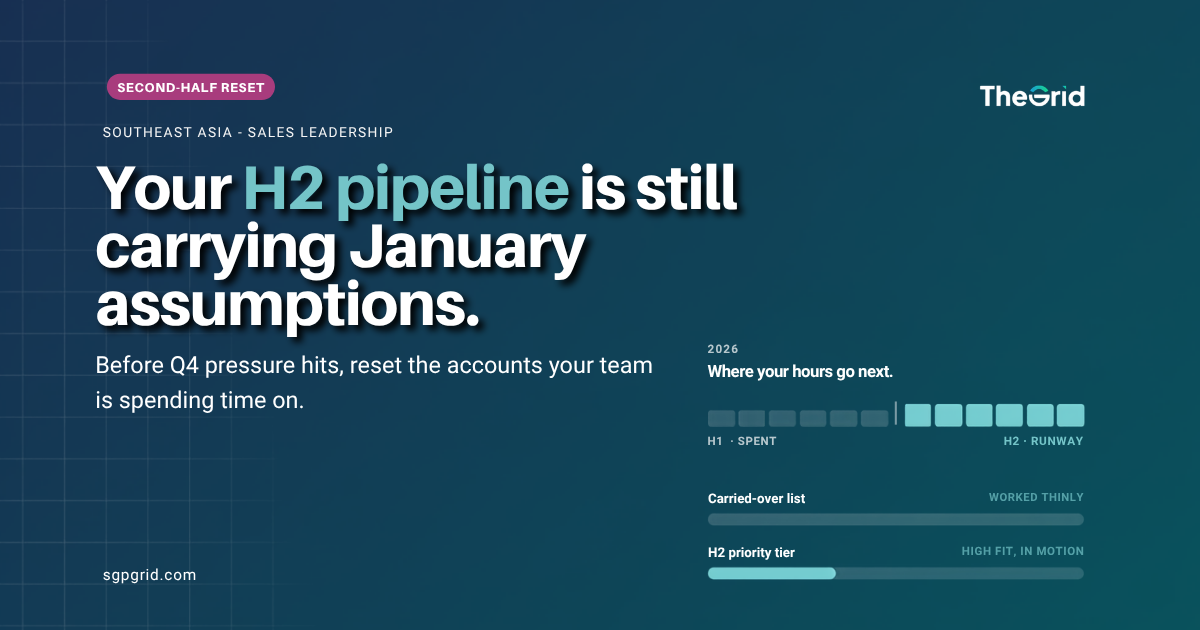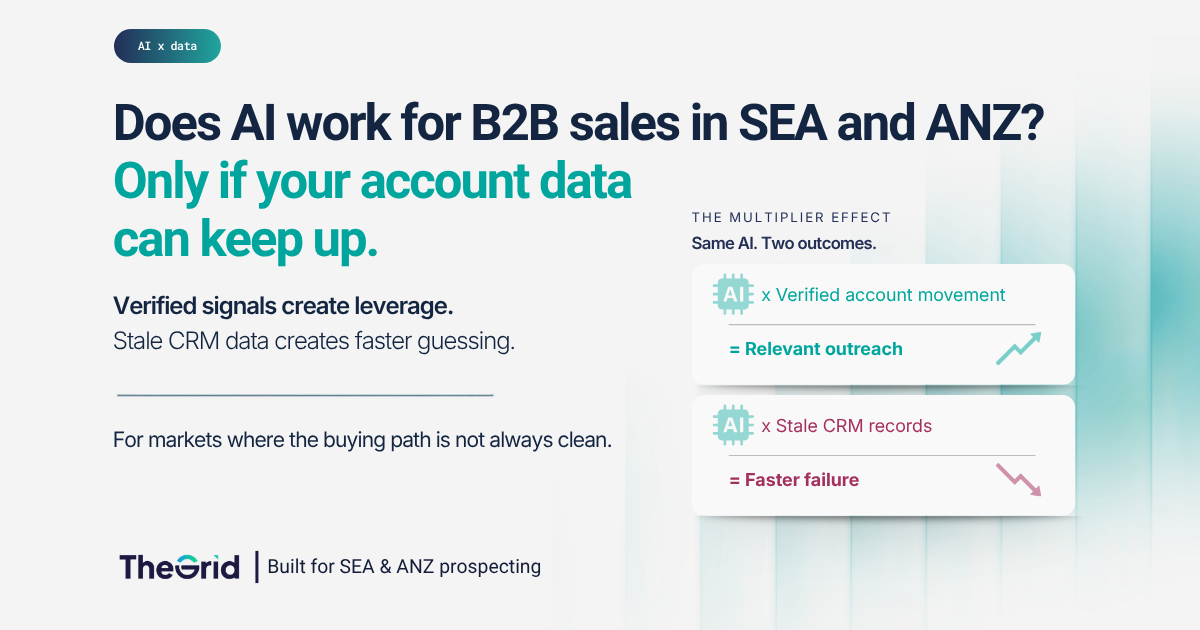
Most B2B teams don’t actually have a pipeline problem.
They have a signal interpretation problem.
What feels like unpredictability is usually something more specific:
Signal Misalignment — when the data guiding your outreach doesn’t reflect actual buyer readiness.
You see activity.
But activity isn’t intent.
You see leads.
But leads aren’t momentum.
And when those signals get confused, the pipeline doesn’t just slow down—
It becomes something you can’t trust.
The Real Issue Isn’t Effort. It’s Signal Quality.
When the pipeline feels inconsistent, most teams respond the same way:
- Send more emails
- Add more leads
- Increase activity
But more volume doesn’t fix bad signals.
It just scales confusion.
Pipeline doesn’t become predictable through effort.
It becomes predictable through accuracy.
The 3 Signal Mistakes Behind “Unpredictable” Pipeline
Most teams aren’t lacking effort.
They’re operating on the wrong inputs.
1. Activity Signals ≠ Buying Signals
Open rates, clicks, replies—these show engagement, not intent.
Someone can engage and still have zero urgency to buy.
2. ICP Fit ≠ Timing
Just because a company fits your ideal profile doesn’t mean they’re ready.
Good targeting without timing still leads to stalled deals.
3. Volume ≠ Momentum
More leads don’t fix pipeline.
They just create more noise.
When you rely on these proxies, pipeline feels inconsistent—
because the signals behind it were never reliable to begin with.
What Actually Counts as a Buying Signal?
A buying signal is any observable change that indicates a company is moving closer to a decision.
This shows up as:
- Hiring for roles tied to your solution
- New funding or budget expansion
- Market expansion or new geographic focus
- Internal shifts (new leadership, restructuring)
These are not engagement signals.
They’re momentum signals.
And momentum—not activity—is what makes a pipeline predictable.
The Hidden Friction in SEA B2B Prospecting
Southeast Asia is not a single market.
It is a network of six distinct business cultures, and what converts in the US or Europe often quietly dies here.
🇸🇬 Singapore
Singapore feels like the easiest market to enter.
Polished LinkedIn profiles.
Impressive regional titles.
Gleaming office addresses.
Do not be fooled.
Behind the enterprise polish sit multi-layered decision structures where the person you are talking to is rarely the person who signs anything.
A deal that feels warm in week two can quietly stall in procurement for six months waiting for sign-off from a regional VP you have never met.
🇵🇭 Philippines
In the Philippines, the org chart is a suggestion.
The real decision map lives in personal relationships.
The person who quietly vouches for you in a Viber group chat often carries more weight than the official decision-maker who attended your demo.
If you have not invested in trust before the pitch:
You are not really in the conversation. You just think you are.
🇲🇾 Malaysia
A Malaysian SME can look completely independent — and still have its real budget decisions made three layers up.
Meetings go well. Interest is there. Then nothing moves.
Not because the deal died. But because the real decision-maker was never in the room to begin with.
🇮🇩 Indonesia
Indonesia is no longer just Jakarta.
Tier-2 cities are rising. Opportunities are everywhere.
The founder says yes in the meeting.
Then four other people need to say yes.
Then the founder confirms again.
Then someone asks for another presentation.
You are back at slide one.
🇹🇭 Thailand
In Thailand, the deal does not live in your inbox.
It lives at the lunch table.
Senior decision-makers are not ignoring you.
They are just not on the channels you are using.
Follow-ups do not build urgency here.
🇻🇳 Vietnam
Vietnam does not announce momentum loudly.
It shows up in hiring.
A company can look quiet on LinkedIn — and already be expanding, allocating budget, and moving fast.
If you are not watching hiring signals:
You are arriving at a party that started three months ago.
“A company can look perfectly qualified on LinkedIn and still be six months away from any real conversation.
Another can look invisible and already be moving.
The difference is not the data. It is momentum.”
The Shift: From Activity to Momentum
The goal isn’t to do more outreach.
It’s to work with better signals.
Because when you can see:
- who is actually in motion
- what changed inside a company
- and when timing becomes real
Pipeline stops feeling random.
It starts feeling like something you can read.
The Operational Gap: Good Signals, No System
Inside most teams, signals exist.
An SDR notices hiring.
A marketer spots funding.
A founder hears expansion news.
But everything stays scattered.
No shared framework.
No scoring logic.
No alignment.
So prioritization becomes:
Gut feel dressed up as strategy.
I’ve seen this pattern repeat across teams scaling across SEA in different industries, with the same blind spots.
The Pain Nobody Puts in the Deck
Every week your team spends chasing companies that are not moving…
…is a week someone else is already talking to the ones that are.
In Southeast Asia, timing is not a small advantage.
It is often the only advantage.
The company that gets there earlier:
- Shapes the shortlist
- Frames the criteria
- Sometimes writes the brief
By the time your team validates the signal…
The window has already moved.
Not closed.
Moved. To someone else.
A Practical Signal-Based Lead Prioritization Framework
To operationalize momentum, I built a toolkit.
Not theory.
Not slides.
A working system.
What it does:
- Defines your real ICP (not just ideal logos)
- Scores accounts based on actual momentum
- Shows which “invisible” companies matter more than visible ones
- Aligns Sales, Marketing, and RevOps around the same signals
Think of it as a lens.
It will not find every signal for you.
But it will change how your team sees.
The Part No One Talks About
Seeing momentum is one thing.
Keeping up with it is another.
Across all these SEA markets, the pattern is the same:
You’re not lacking leads.
You’re lacking clear, reliable signals.
On paper, this sounds simple:
Track hiring.
Watch expansion.
Monitor funding.
Until your SDR is juggling:
- LinkedIn tabs
- Job boards in three languages
- News across five countries
- And a CRM that still thinks “last contacted” matters
At that point:
It is no longer strategy. It is survival.
Where Most Teams Actually Break
The issue is not understanding signals.
It is keeping up with them at scale across Southeast Asia.
Because this market is:
- Fragmented
- Private-company heavy
- Relationship-driven
- Cross-border complex
So what happens?
- Good accounts look quiet → ignored
- Dead accounts look qualified → pursued
- SDRs research more than they sell
- Pipeline reviews become storytelling sessions
TheGrid: Built for This Specific Problem
The toolkit helps your team think better.
TheGrid helps your team move faster with real visibility.
This is not a polite upsell.
It is the honest next step.
Once you try tracking:
- Indonesian expansion
- Vietnamese hiring
- Malaysian ownership
- Philippine relationship signals
You realize something quickly.
This is not a spreadsheet problem.
It is not a headcount problem.
It is a signal infrastructure problem.
And most teams don’t realize that until they’ve already missed the accounts that mattered.
TheGrid surfaces companies that are already:
- Hiring
- Expanding
- Entering new markets
- Shifting leadership
Across Southeast Asia.
In one place.
So your SDR does not ask:
“Should I reach out to this account?”
They already know:
“This company is moving. Talk to them now.”
The toolkit is the lens.
TheGrid is the engine.
You need both.
The Real Upgrade Is Not Better Targeting. It Is Better Timing.
In SEA, timing is not an edge.
It is the game.
The difference between:
- being ignored
- and being welcomed
…is often just a few months.
The toolkit tells you which accounts matter.
TheGrid tells you when they matter.
That is the difference between:
- a pipeline that looks busy
- and a pipeline that actually moves
Before Your Next Pipeline Review
Do not start with your best accounts.
Do not start with your dream logos.
Pick 10 average prospects.
Run them through the scorecard.
You will immediately see:
- which ones are actually in motion
- and which ones never were
Once you see that pattern…
You cannot unsee it.
The toolkit is free.
Your next pipeline review is already coming.
The only question is whether you’re walking into it with clarity — or guesses.
→ Download the Lead Momentum Scorecard Toolkit.
Want to Go Deeper?
- B2B Lead Generation 101: The SME Guide to Quality Leads in Singapore and SEA
- Inbound vs Outbound Lead Generation: What Works Best For SMEs in SEA
- Smart Prospecting: How to Target the Right Companies, Not Just More Companies
- Using Firmographics, Technographics, and People Data to Prioritize B2B Leads
Explore more insights on The Grid Academy.