TL;DR
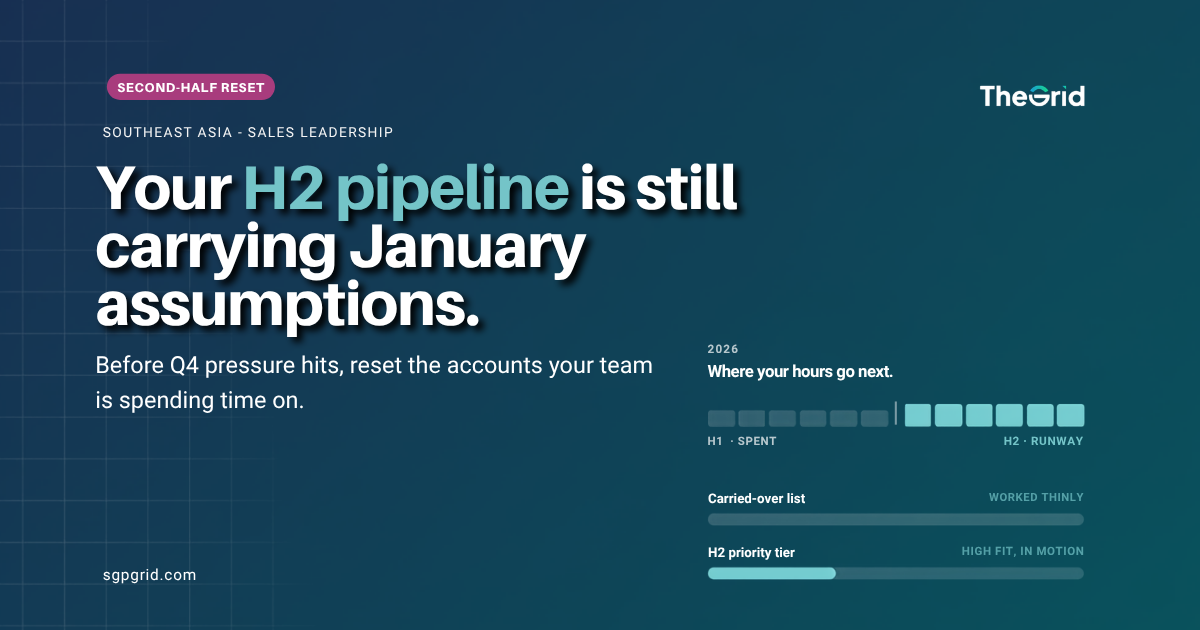
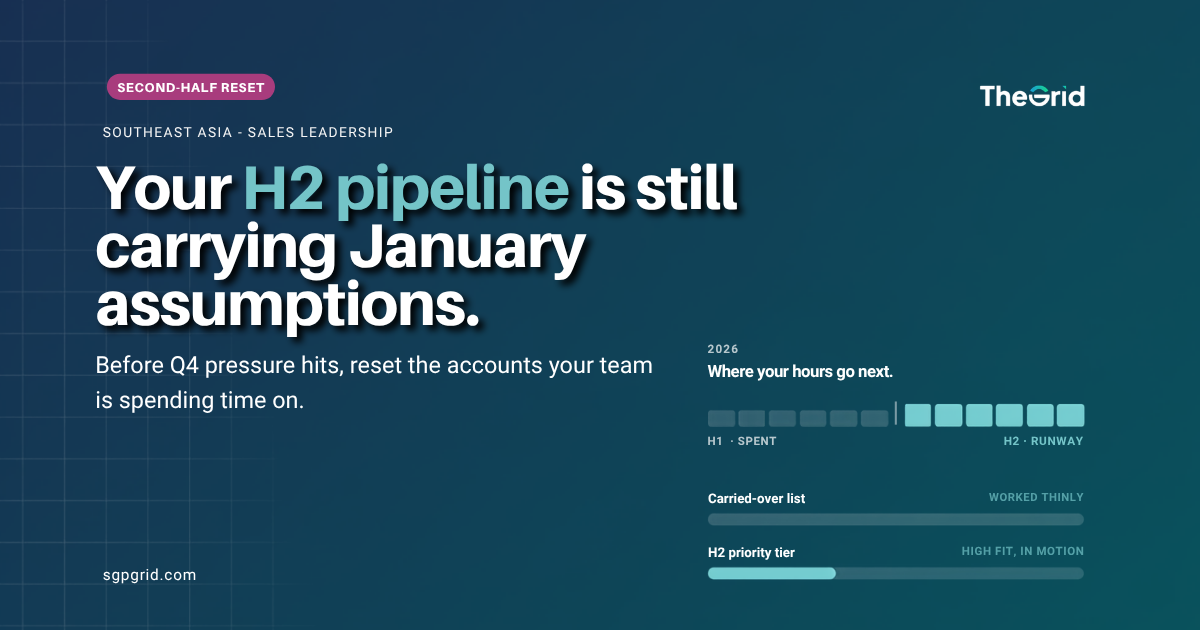
The account list you built in January is not the same list by August; you just cannot see the difference. Contacts have moved, companies have restructured, some entities have closed, and priorities have shifted faster than the list ever shows on screen. Most Southeast Asian teams carry that decayed list straight into the second half and blame the quarter when nothing converts. A second-half account reset addresses the problem in four moves: purge what no longer belongs, re-verify the remaining company and contact context, re-segment accounts by current fit and movement, and re-focus seller effort on the accounts that still deserve attention.
The four moves:
1. Purge: remove closed, merged, and irrelevant accounts.
2. Re-verify: confirm entities and contacts are still real and current.
3. Re-segment: group by movement and fit, not by January's assumptions.
4. Re-focus: point limited rep hours at the accounts most likely to move in the second half.
Your January list may no longer reflect August reality
At the start of the year, your account list felt sharp. Researched, segmented, aligned to targets. Six months later, it still looks the same in your CRM, same names, same companies, same tidy rows. That is exactly the problem. It looks unchanged while the reality behind it has quietly moved on.
The scale of the drift is easy to underestimate. Marketing Sherpa research widely cited by HubSpot puts B2B contact data decay at roughly 2.1% per month, about 22.5% a year, which means close to a quarter of your records can go stale within twelve months. That is the global baseline. For teams selling across Southeast Asia and ANZ, keeping account context current can be especially challenging because available company, contact, and public-record information varies by market and source.
So your reps spend the second half working a map of a place that no longer exists. Activity stays high, pipeline stays flat, and everyone assumes the problem is effort or messaging. Usually it is the list, the same upstream issue behind most outbound that never gets a reply.
Why the second-half checkpoint matters
The second half is not a fresh start you get for free; it is a checkpoint most teams skip. New quarterly targets land, budgets get re-examined, and leadership wants the pipeline to move. If you begin that stretch on top of a decayed list, you are already behind before the first call of the second half.
A reset before Q4 planning and pipeline pressure intensify does two things: it removes the wasted motion of chasing dead accounts, and it re-points your team at where the real opportunity has moved to since January. Even a focused review of the highest-priority accounts can expose wasted effort before it compounds through the rest of the quarter.
There is a hidden cost too. Every wasted touch on a dead account is not just lost time; it trains reps to distrust the list and to freelance their own targeting, which quietly erodes any shared view of pipeline. A clean list is not only more efficient, but it also keeps the whole team pointed at the same reality, so forecasts mean something and coaching has a foundation to work from.
The 4-step second-half account list reset
Step 1: Purge the dead weight
Start by removing what should not be there anymore. Go through your active list and cut:
· Companies that have closed, merged, or been acquired since January.
· Accounts that no longer fit your ICP after any strategy shift this year.
· Duplicates and records with no reachable contact at all.
This is uncomfortable; a shorter list can feel like less pipeline. It is not. It is a more honest one. You cannot prioritise well when the list is padded with accounts that were never going anywhere.
Step 2: Re-verify what survives
For the accounts that remain, confirm they are still real and current. The two questions that matter:
· Is the entity still the entity? Same registration, structure, and status you assumed in January?
· Is the contact still the contact? Same person, same role, same company?
For regional teams, verification matters because company structures, available public records, and contact visibility are not uniform across markets. A single source will not always tell the whole story. Where official registry information is available, it can provide an additional layer of entity verification, helping teams confirm company status and structure alongside other company and contact sources.
Step 3: Re-segment by movement, not by January's assumptions
Your original segments reflected what you believed in January. Six months of change means those buckets are probably wrong. Re-sort the surviving accounts by two lenses:
· Fit: do they still match your ICP as it stands today?
· Movement: is anything happening right now? Hiring, leadership changes, funding, business updates.
The accounts that score high on both are your H2 priority tier. High-fit but no-movement accounts move to nurture until something changes. This is the shift from a static list to a live one, and it is the same movement-first thinking behind coaching reps on buying signals.
Step 4: Re-focus rep effort for H2
Finally, match effort to the new segmentation. Concentrate your reps' best hours on the priority tier, the high-fit, in-motion accounts, and let the rest sit in a lighter-touch nurture flow. In a second half where budgets and time are usually tighter, focus is the multiplier. Fewer, better-chosen accounts, worked properly, beat a long list worked thinly.
A practical way to hold the line: give the priority tier a defined touch cadence and a clear owner, and put everything else on a low-effort monthly check rather than active outreach. The point of the reset is not to delete accounts forever; it is to stop spending your best hours on accounts that have not earned them yet. When a nurture account shows movement, it graduates back into the priority tier.
An illustrative scenario
Picture two SEA sales teams of similar size heading into H2.
Team A skips the reset. They carry their January list of 500 accounts straight into Q3 because it still looks full, and cutting it feels like losing pipeline. Through July and August, reps burn hours on companies that have restructured, contacts who left months ago, and a handful of closed businesses. Dials are high, connect rates are low, and leadership keeps asking why a busy team is not converting. The list still looks healthy. The selling opportunity behind it isn't.
Team B spends one afternoon on the reset first. They purge roughly 150 dead or off-ICP accounts, re-verify the rest, and re-segment down to about 120 high-fit accounts showing real movement. Their list is smaller, and it feels uncomfortable, but every account has a reason to be there. Reps spend the second half on live opportunities instead of chasing the past, and Team B does not automatically win more deals. What changes is where the team's limited selling time goes: toward accounts that still fit, still exist, and have a current reason to be worked.
What a good reset actually feels like
A team that resets well walks into the second half with a shorter, sharper, verified list where every account has a reason to be there. Reps stop wasting calls on companies that changed shape months ago. Leadership sees a pipeline that reflects reality instead of January's optimism. And as Q4 targets come into focus, the team is aiming at live opportunities, not chasing ghosts from the first half.
The reset is not busywork. It is the difference between starting the second half on solid ground and starting it already behind.
Where TheGrid fits
A second-half reset is only as useful as the context you reset against.
TheGrid helps teams review SEA and ANZ accounts using multi-source company and contact intelligence, combining business information, people data, and account context to reduce some of the manual work involved in checking whether an account still fits.
Where official registry information is available and supported, it can add another layer of company verification. Account context can also help teams apply the fit-and-movement thinking used in Step 3.
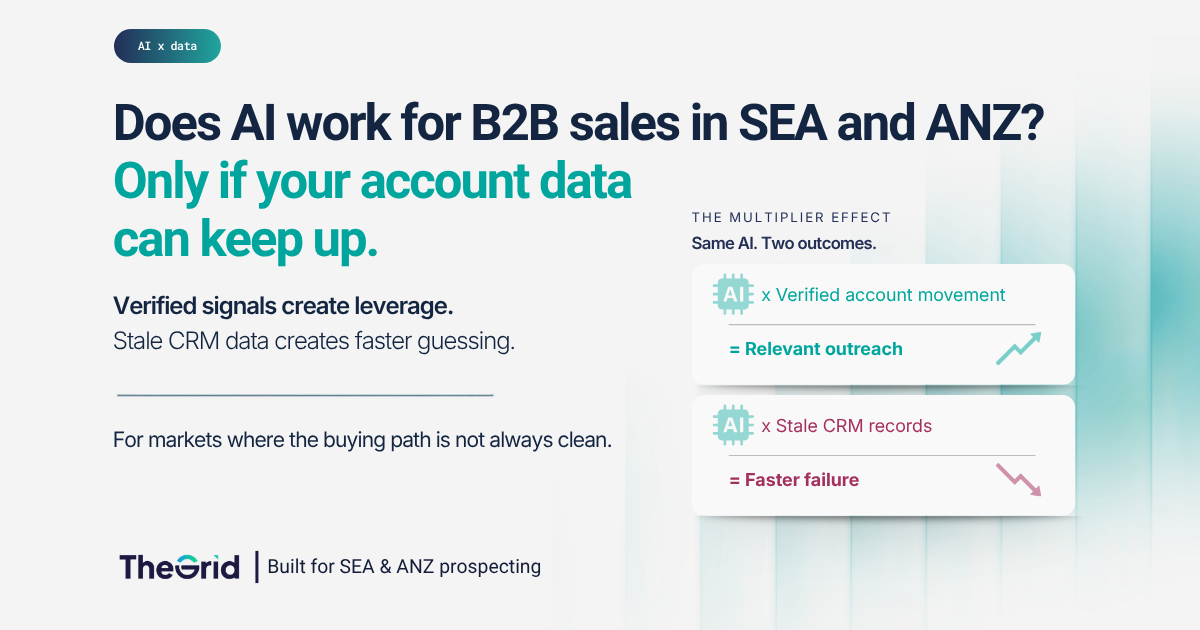
The point is not to automate sales judgment. It is to give that judgment better context. If you are also rethinking your tooling, it is worth being honest about what AI can and cannot do with that data.
FAQs
How often should you clean up your sales account list?
At minimum, consider a deeper review around major planning checkpoints such as mid-year and year-end. Between those resets, a lighter monthly review of priority accounts can help catch changes earlier. Multi-source intelligence platforms such as TheGrid can reduce some of the manual work involved in reviewing company and contact context across target accounts.
What is a second-half account list reset?
It is a structured review of your account list before the second half begins: purging dead accounts, re-verifying the ones that remain, re-segmenting by current fit and movement, and re-focusing rep effort. The goal is to enter the next half working real opportunities instead of a decayed January list.
Why can pipeline momentum stall in the second half?
Often because the account list has quietly decayed. Contacts moved, companies changed, and some accounts are no longer real, but the list still looks full. Activity stays high while conversion drops. A reset re-points effort at accounts that are actually in motion.
How do you segment B2B accounts effectively?
Segment on two lenses at once: fit (do they match your current ICP?) and movement (is anything happening right now that creates a reason to engage?). Accounts high on both are your priority tier. High-fit but static accounts go to nurture until a signal appears.
Start your reset this week
You do not need to overhaul everything at once. Take your top 50 accounts and run just Step 1 and Step 2, purge the dead ones, re-verify the rest. You will likely be surprised how many were quietly costing your reps time. That single pass is usually enough to prove the reset is worth doing across the whole list.
Reset your priority accounts with better SEA company and contact context. Explore TheGrid.
Sources
ACRA, Accounting and Corporate Regulatory Authority (Singapore)
Records carry firmographic and contact fields from public filings and licensed partners.
Related Reading
Does AI Actually Work for B2B Sales in Southeast Asia? The Honest Answer
Outbound Sales in SEA: The Real Reason You are Getting No Replies
How to Coach SDRs on SEA Buying Signals (Not Just Pipeline Numbers)