“Do you know anyone there?”
Before relationship maps, social selling dashboards, enrichment tools and AI prospecting assistants, that was one of the most useful questions a salesperson could ask.
It sounds almost primitive now.
But it was not lazy prospecting.
It was old-school sales intelligence.
The seller was trying to figure out something every modern GTM team still wants to know:
Who knows this company? Who knows someone inside it? Who might trust us enough to make an introduction? And what is the best way into the account?
The technology has changed dramatically.
The question underneath it has not.
Today, finding companies and contacts can happen in seconds. Sequences can reach hundreds of people. AI can research accounts, summarize websites and draft messages before a seller finishes their coffee.
Prospecting became faster.
But faster does not automatically mean smarter.
The real question is whether all that speed helps us understand the account better or simply helps us contact it sooner.
TL;DR: What did old-school prospecting get right?
Old-school prospecting was inefficient, but it forced sellers to gather context before outreach.
Modern sales technology removed much of that manual work. That is a good thing.
The problem starts when automation replaces curiosity instead of supporting it.
Good B2B prospecting still requires three things:
- understanding the company
- identifying the relevant people around the opportunity
- understanding why reaching out now might make sense
That matters particularly when selling across Southeast Asia and ANZ, where an account can involve local teams, regional leadership, finance, procurement and other stakeholders across markets.
The modern standard should not be a return to manual prospecting.
It should be old-school curiosity with modern sales intelligence.
TheGrid is a sales intelligence platform that helps teams find companies and relevant people, enrich contacts with verified details, and add more context to SEA and ANZ prospecting.
But the technology is only useful if sellers still know what questions to ask.
Old prospecting was slow. But it was not mindless.
There was a lot about traditional prospecting that nobody should romanticize.
Printed directories.
Stacks of business cards.
Office switchboards.
Handwritten notes.
Referrals from people who vaguely remembered somebody working somewhere.
Spreadsheets that were probably outdated before they were saved.
And plenty of:
“I think I know someone there. Let me check.”
It was inefficient.
Yet the limitations of the tools created an interesting discipline.
You could not afford to contact everyone.
Finding a prospect took effort.
So sellers often spent more time deciding whether a company was worth approaching and how they might get inside.
Who runs the company?
Who knows them?
Who might introduce us?
Which department would care?
Who actually makes decisions there?
What has changed recently?
Is there a reason to call now?
In other words, sellers were doing account research long before we started calling it account intelligence.
The referral question was part of that process.
It was essentially a primitive relationship graph.
The seller was mapping trust manually.
That is the part worth remembering.
The underrated discipline was research before outreach
Human-centered prospecting is sometimes misunderstood as simply writing friendlier emails.
It is bigger than that.
It starts before the message.
The basic principle is simple:
Understand something before asking for attention.
Old-school sellers often had no choice.
Before contacting a company, they might ask colleagues, partners, customers or friends what they knew about it.
They looked for context because context reduced uncertainty.
Today, that same research question might look like:
Is this actually the right company?
Does it still fit our ICP?
What is happening inside the business?
Which functions are likely to care?
Who else could influence the decision?
Has leadership changed?
Is the company expanding?
Is there any credible reason this conversation should happen now?
Technology should make answering those questions easier.
It should not make the questions disappear.
What automation improved
Modern prospecting solved many problems that deserved to be solved.
A seller no longer needs to spend an afternoon manually building twenty rows in a spreadsheet.
Sales intelligence platforms can surface companies much faster.
Contact data can reduce switchboard hunting.
CRM enrichment can improve incomplete records.
Signals can help teams notice changes inside accounts.
Automation can handle repetitive administrative work.
Sequences can keep follow-ups from falling through the cracks.
AI can summarize information and help sellers prepare faster.
That is progress.
The goal should never be to return to a world of rolodexes and sticky notes.
Manual effort was never the valuable part of old-school prospecting.
Judgment was.
Modern sales technology works best when it removes the repetitive work while giving sellers more room for that judgment.
What automation accidentally weakened
Every efficiency creates a temptation.
When finding one hundred prospects becomes almost as easy as finding ten, the natural response is to find one hundred.
When sending one hundred emails becomes easy, the natural response is to send them.
Then one thousand.
Eventually, prospecting can become a production problem:
More records.
More sequences.
More activities.
More touches.
More emails.
But volume can quietly hide a more important question:
Do we actually understand these accounts any better?
That is where modern prospecting sometimes goes backwards.
A CRM record can contain a company name, job title, email address and phone number while still telling the seller almost nothing about how to approach the account.
And when those records stop reflecting reality, the problem becomes bigger than personalization. B2B data hygiene becomes part of prospecting itself.
The contact exists. The context does not.
And when context disappears, personalization often becomes cosmetic.
“Hi Sarah, I saw you are Head of Operations at Company X…”
That is technically personalized.
It is not necessarily relevant.
The deeper questions remain unanswered.
Why Sarah?
Why this company?
Why now?
Who else matters?
What business movement makes the conversation worth having?
Automation solved much of the work of finding names. It did not solve the judgment of deciding which names matter.
Why this matters when prospecting across SEA and ANZ
Regional prospecting creates another layer of complexity.
A company operating across Singapore, Malaysia, Thailand, Indonesia, the Philippines, Australia or New Zealand may appear as one account in your CRM.
The buying path may be much less tidy.
A local team may experience the problem.
A regional leader may own the project.
Finance may control the budget.
Procurement may influence the process.
Another stakeholder may determine whether the initiative gets internal support.
Not every company works this way.
That is precisely the point.
You cannot safely infer the buying path from geography or job title alone.
And the visible contact is not automatically the complete account story.
This is why B2B prospecting in Southeast Asia requires more than a country filter .
Sellers need enough context to form a reasonable hypothesis about the account before starting the conversation.
Not certainty.
Context.
Good sales intelligence should help a seller ask better questions, not pretend it already knows every answer.
Finding the company is not the same as finding the buying path
This distinction is easy to miss.
Finding a company answers:
Does this organization fit our target market?
You might look at:
- geography
- industry
- company size
- business model
- growth
- financial information
- other firmographic characteristics
Important?
Absolutely.
But that is only the account.
Finding a contact answers:
Who can we potentially speak to?
You might look at:
- function
- seniority
- location
- contact details
- professional background
Also important.
But that still does not necessarily reveal how a decision happens.
Finding the buying path asks:
Who might matter around this opportunity?
What has changed?
Where might the business need sit?
Who could influence the conversation?
What should we learn before outreach?
And what do we still need to discover once the conversation begins?
That is a different level of prospecting.
A company record tells you where to look. A contact gives you someone to reach. Account context helps you understand how to begin.
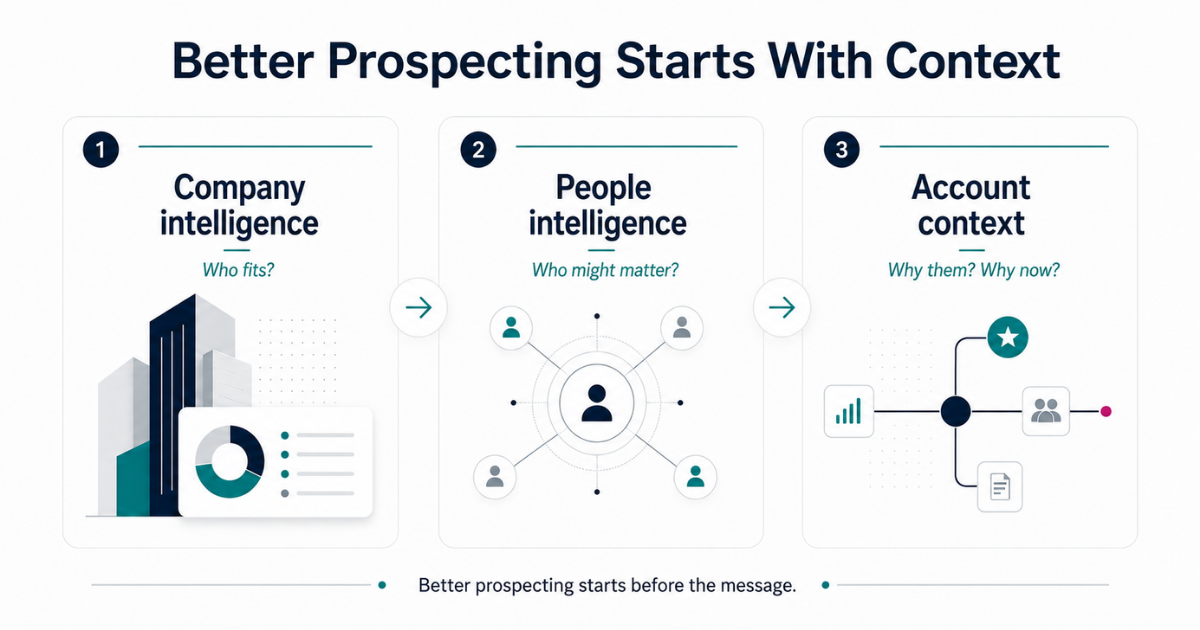
That distinction also shows up in customer feedback. One senior partnerships leader at TheGrid client described the platform as “a major plus point” in sales prospecting, particularly for segmenting companies, identifying stakeholders, and accessing verified email addresses while mapping the Singapore market.
The referral question was really asking about trust
Consider what somebody meant when they asked:
“Do you know anyone there?”
They were not necessarily looking for a random employee.
They wanted a bridge.
Someone who could provide context.
Someone who might make an introduction.
Someone who could explain how the company worked.
Someone who reduced the distance between seller and buyer.
The referral itself was valuable because trust helped create relevance before the pitch arrived.
That instinct still matters.
But relying entirely on referrals has obvious limits.
Your network may not reach the market you want.
The person you know may have moved.
Their information may be incomplete.
Your sales team may be expanding into a country where nobody has useful relationships yet.
That is why the modern upgrade should not be:
“Stop asking who knows someone.”
It should be:
Stop depending on that question as your only source of intelligence.
Use the relationship when you have it.
Build account intelligence when you do not.
The new standard: old-school curiosity, modern sales intelligence
The best modern prospecting workflow should preserve the instincts that made good traditional sellers effective.
Before outreach, ask five questions.
1. Is this the right account?
Start with fit.
Does the company genuinely match the market you serve?
2. What do we know about the company?
Understand the business before reducing it to one CRM row.
Look at its activities, size, market presence and other relevant company context.
3. Who might matter?
Do not stop at the first plausible title.
Look at the functions and people connected to the problem you solve.
Your first contact may become your buyer.
Or your guide to the buyer.
You will not know until you start learning.
4. What has changed?
B2B buying signals can give sellers a better reason to investigate the account.
A signal is not proof of purchase intent.
It is a reason to ask a more informed question.
5. Why should this conversation happen now?
This is where context becomes outreach.
Not:
“We help companies like yours.”
But:
“We noticed something relevant about your business. Is this creating a problem worth discussing?”
That is a much more human place to begin.
Human-centered prospecting is not anti-automation
This distinction matters.
Human-centered prospecting does not mean manually researching every company for an hour.
It does not mean abandoning sequences.
It does not mean refusing to use AI.
It does not mean replacing your CRM with business cards again.
It means using technology to create better-informed human conversations.
Automation should reduce administrative friction.
Sales intelligence should improve context.
Signals should improve timing.
AI should help sellers synthesize information faster.
And the seller should still apply judgment.
Human-centered prospecting is not anti-automation. It is anti-contextless automation. TheGrid's view of modern prospecting is simple: use technology to remove the manual work, not the seller's curiosity.
Where TheGrid fits into the modern prospecting workflow
This is where old instincts meet the modern workflow.
The question is no longer simply:
“Can I find someone at this company?”
A better prospecting workflow asks:
“What do I know about the company, who might matter, what has changed, and where should I start?”
TheGrid brings those layers of account research together for teams prospecting across SEA and ANZ.
Start with the company
Before looking for a name, understand the organization.
Teams can explore company information such as industry, headquarters, headcount, countries of operation, and other firmographic context to determine whether an account deserves attention.
Explore the people around the account
A visible job title is only one clue.
TheGrid lets teams explore people across functions, seniority levels and locations, alongside available contact details.
That gives sellers more starting points than simply finding the first person with “Head of” in their title.
Look at what is changing
Company movement can help make timing less arbitrary.
Signals such as hiring or headcount changes can give sellers a reason to investigate what may be happening inside an account.
A signal is not proof that somebody is ready to buy.
It is context for a better question.
Understand more of the business behind the record
Where available, company profiles can also surface financial, legal-entity and corporate-structure context.
That matters because the organization a seller sees on LinkedIn may not tell the whole story about the entity, market presence or business structure behind an account.
Expand intelligently
Lookalike-company discovery can also help teams move from one relevant account to other businesses worth researching rather than rebuilding every prospect list from scratch.
The point is not to collect every possible field.
It is to put enough context around an account that the seller can make a better decision about who to approach, what to investigate and why the conversation may be relevant now.
TheGrid does not remove the need for seller judgment.
It gives that judgment more to work with.
Because the goal of sales intelligence should not simply be:
“Give me someone to email.”
A better goal is:
“Help me understand where this conversation should start.”
The best sales technology should make sellers more curious, not less
There is an irony in modern prospecting.
We have more information than previous generations of sellers could have imagined.
Yet it has never been easier to reach someone without knowing very much about them.
That is the trade-off sales teams need to manage.
Speed is useful.
Scale is useful.
Automation is useful.
But none of them replaces relevance.
The winning workflow is not old versus new.
It is old plus new.
Keep the curiosity.
Keep the instinct to map the account.
Keep looking for the path into the conversation.
Leave behind the manual directories, stale spreadsheets, and total dependence on personal referrals.
Then use modern sales intelligence to do the research faster and with better context.
Because prospecting should not just become faster.
It should become smarter.
A note on sales intelligence
No data point or account signal can fully explain how a company will make a buying decision. Company information, people data, and business signals should be used to form better prospecting hypotheses. Sellers still need to validate relevance, timing, and decision dynamics through research and conversation.
FAQ
What is human-centered prospecting?
Human-centered prospecting is a B2B sales approach that uses data and technology to create more relevant human conversations rather than simply increasing outreach volume.
It combines account research, relevant contact discovery, business context and timing with human judgment before and during outreach.
The goal is not to automate the relationship.
The goal is to automate enough repetitive work that sellers can spend more attention understanding the buyer.
Why was “Do you know anyone there?” a form of sales intelligence?
The question helped sellers gather information about relationships, trust and possible paths into an account.
Before relationship-mapping software and digital sales intelligence, professional networks often provided information about who worked where, who knew whom and how an introduction might happen.
It was manual and difficult to scale, but the underlying objective remains relevant today: understand the account before approaching it.
Is manual prospecting better than automated prospecting?
No.
Manual prospecting involves significant repetitive work and does not automatically produce better outreach.
The useful lesson from older prospecting methods is not the manual process. It is the discipline of researching the account before contacting it.
Modern teams can combine that discipline with sales intelligence, CRM enrichment, automation and AI.
What is the difference between contact data and account intelligence?
Contact data helps you identify and reach a person.
Account intelligence gives you broader information about the company and activity around the account that may help explain why a particular person, conversation or moment matters.
Strong prospecting usually needs both.
A valid email address answers how to reach someone.
Account context helps answer why you should reach them.
What should B2B sellers research before outreach?
Before contacting an account, sellers should ideally understand:
- whether the company fits their ICP
- relevant company information
- potential stakeholders or functions
- recent business movement
- possible reasons for outreach
- what they still need to learn during discovery
You do not need perfect information before sending an email.
You need enough context to avoid treating the buyer like another row in a list.
Why does account context matter in SEA and ANZ prospecting?
Companies selling across SEA and ANZ may encounter different company structures, regional responsibilities and decision processes across accounts and markets.
A local contact may be highly relevant without controlling the entire buying process. Regional teams, finance, procurement or other stakeholders may also become involved.
That makes it useful to understand the wider account instead of relying exclusively on one visible title.
Does sales intelligence replace referrals?
No.
A trusted introduction can still be extremely valuable.
Sales intelligence expands the seller's ability to research accounts when a direct relationship or referral is unavailable.
The better approach is not referral or intelligence.
It is using every credible source of context available to understand the best path into the account.
Keep the instinct. Upgrade the workflow.
The question “Do you know anyone there?” still teaches us something useful.
Good prospecting has always been about more than finding a name.
It is about finding the right way into a conversation.
Today, sellers no longer need to depend entirely on business cards, memory, personal introductions or another spreadsheet to do that work.
Keep the curiosity that made old-school prospecting effective.
Then give it better tools.
Start prospecting with TheGrid and build more company, contact, and account context before your next SEA or ANZ outreach.