TL;DR
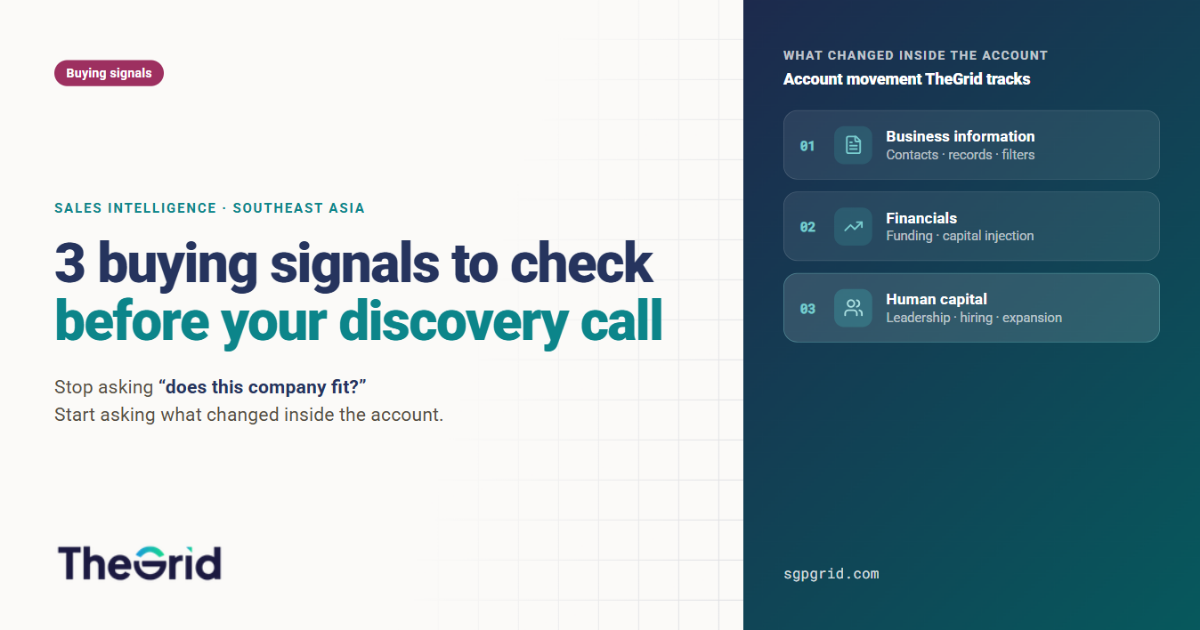
A good discovery call starts before the call. Inside TheGrid, account movement is grouped into three signal categories:
1. Business information update
2. Financials
3. Human capital
Between them, these categories surface practical clues: contact updates, fresh funding, leadership changes, hiring momentum, planned expansion, and stakeholder movement.
In the SEA market, treat signals as a head start, not a verdict. They help sales teams form sharper hypotheses before the call, while discovery confirms timing, urgency, and buyer path.
The best teams don't wait for a prospect to say they're ready. They look for what changed, build a stronger “why now” around it, and walk into the call ready to confirm timing, decision-makers, and next steps.
The three B2B buying signals to check before a discovery call in Southeast Asia are business information updates, financials, and human capital movement. Together, they help sales teams understand whether an account has changed, whether the timing may be relevant, and whether there is a stronger reason to start a sales conversation now.
The hard truth about ICP-fit accounts
You can have the perfect pitch and still lose the deal. Not because the product was wrong, and not because the buyer was rude, but because the account was never ready. It happens across Southeast Asia every day.
A sales team in Singapore builds a list of fast-growing companies. On paper, they're flawless: industry fits, headcount fits, revenue looks promising. But nothing is moving inside those accounts. No new priority.
No trigger.
No reason to act now, so the calls are polite and flat.
In Malaysia, a rep reaches a company expanding into a new market. The prospect takes the call and delivers the classic line: “Interesting. Let us discuss internally.” Then the deal quietly disappears, not because there was no interest, but because the rep never found out who “internally” actually meant.
The pattern repeats. In Indonesia, growth plans are announced, but approval still sits with a regional team, so the helpful local contact isn't the economic buyer.
In the Philippines, a new department is hiring, but the person feeling the pain doesn't control the budget.
That's the quiet problem with B2B sales in SEA: a company can match your ICP perfectly and still be a bad prospect today. So, the better question isn't “does this company fit?” It's “what changed inside this account that could make the problem urgent now?” That's where better prospecting starts.
What are SEA buying signals?
SEA buying signals are account movements that help you judge whether a company is worth contacting now. They aren't magic intent data, but they're clues. A signal might tell you that something changed in the company record, new funding came in, a team is hiring, leadership shifted, a department is growing, or a stakeholder moved.
What a signal doesn't do is prove budget, urgency, or intent. What it gives you is a better reason to start the right conversation.
Why static ICP lists aren't enough in Southeast Asia
Static lists tell you who might fit. They don't tell you who's ready — and in SEA, buying paths are usually layered. A Singapore HQ may hold the budget while a Malaysia country team feels the problem, a Philippines ops team uses the tool, and an Indonesia regional lead signs off. A founder, finance lead, or procurement team can quietly shape the outcome from the side.
So the public-facing buyer often isn't the real buying path. The person who replies may not own the budget; the person with the title may not own the influence; the company that looks active may not be ready. Signal-led prospecting is what lets you walk in with context instead of assumptions.
The 3 signal categories to check before a discovery call
Before your next discovery call, check the three account movements TheGrid tracks. You don't need ten clues — you need one strong signal and one clear hypothesis.
1. Business information update
This tells you something in the account record changed: updated contact details, a change to a shortlisted company, or a new company matching your saved filters. It sounds like admin work. It isn't.
In SEA, stale information quietly burns pipeline. You call the wrong contact, email a dead address, or chase a company that no longer fits while missing a new one that now does. The list looks clean, but the motion is already outdated. In a region where companies run through local entities, subsidiaries, and regional offices, freshness isn't a small detail; it's pipeline protection.
A better opener:
“I saw a recent update on your company profile, so I wanted to reach out with the right context. Is your team still the right group to talk to about this?”
2. Financials
A financial signal flags fresh funding or a capital injection — one of the clearest reasons to check whether priorities may have shifted. But funding doesn't automatically mean buying intent. A newly funded Singapore company might be expanding its sales team; a Malaysian business might be investing in operations; an Indonesian one might be opening a branch — or the money might still be uncommitted. That's exactly why the discovery call matters. The signal opens the door; the conversation confirms whether it's worth walking through.
Skip “do you have a budget now?” Ask instead: “what changed after the funding?”
A better opener:
“I noticed your company recently raised. That usually creates pressure around growth, hiring, or expansion. Is any of that showing up for your team this quarter?”
3. Human capital
This flags changes in people, leadership, teams, or expansion plans, including headcount shifts, management changes, new leadership, and department hiring. For sales teams it's often the most revealing category, because people movement shows where pressure is building. A new sales leader reviews pipeline quality. A new country manager rethinks coverage. A growing department needs better systems. A planned expansion creates fresh account-mapping problems.
This is where the generic pitch fails. The buyer doesn't need “we help companies like yours.” They need “we noticed this change, is it creating pressure now?”
One more reason people movement matters: a key contact leaving can kill a deal outright. LinkedIn’s APAC State of Sales research found that 81% of sellers had deals lost or stalled in the past 12 months because a key stakeholder left a client or prospect company.
Better openers, by trigger:
Hiring momentum: “I saw your team has been hiring across regional sales and ops. When teams grow that fast, the hard part is usually keeping account visibility and handoffs clean. Is that something you're working through?”
Leadership change: “I noticed a leadership change. New leaders usually review what's working, what's noisy, and what to fix first. Has that started on your side yet?”
Planned expansion: “Looks like you're preparing to expand. That usually means teams need better visibility into accounts, contacts, and local decision-makers. Is that a priority yet, or still early planning?”
How to use signals before a discovery call
Don't bring ten signals into the call, that feels creepy. Bring one sharp signal and one strong hypothesis. The difference is everything:
Weak: “I noticed your company is growing, so I wanted to connect.”
Better: “I noticed your team has been expanding across Malaysia and Singapore. When that happens, sales teams often hit account-mapping and decision-maker-visibility issues. Is that showing up for your team yet?”
The second gives the buyer something specific to respond to. “Yes, that's happening.” “Not quite, but something similar.” “No, not a priority.” All three answers are useful. A good signal doesn't force the buyer into your story, it gives them a relevant place to start.
The signal-led discovery flow
1. Start with the signal.
2. Connect it to a likely business problem.
3. Ask if the problem is real.
4. Confirm whether it matters this quarter.
5. Map who else is involved.
6. Secure the next step with the right people.
In practice: “I reached out because your team is expanding into new SEA markets. When that happens, prospecting gets harder — company data, local decision-makers, and buying signals stop being consistent across markets. Is that something you're dealing with now, or still ahead of you?”
If it's happening now, you have timing. If it's later, you have nurture. If someone else owns it, you have a stakeholder path. Any answer moves you forward — that's the real value of signal-led prospecting: you qualify faster without sounding generic.
The mistake to avoid
Don't treat a signal as proof of intent. Again, a signal is not a deal, it's a reason to ask a better question. The best teams don't use signals to manufacture urgency; they use them to find out whether urgency is real. That's the line between relevant outreach and clever spam. A trigger opens the door. Discovery still has to prove the door is worth walking through.
Mini checklist: is this account ready for outreach?
Run this before you sequence an account.
1. Company fit. Does it match your real ICP — industry, headcount, geography, model, size? If it doesn't fit, no signal will save it.
2. Account movement. Has something changed recently — a business information update, a financial change, human capital movement? If nothing has, the account probably belongs in nurture.
3. Pain connection. Does the signal connect to a problem you solve? Funding only matters if it creates pressure you can help with; leadership change only matters if it opens a problem you can credibly speak to. Chase movement that connects to pain, not movement for its own sake.
4. Decision-maker path. Can you name who owns or influences the decision — economic buyer, finance owner, procurement, ops leader, regional stakeholder? If it's unclear, your first call should map it.
5. Timing. Is this a now problem or a someday problem? Tie it to a quarterly goal, deadline, or active project. No timing doesn't mean no opportunity — it means nurture until the signal strengthens.
6. Next step. Can the account move after the first call? “I'll send more info” is not a next step. “Let's bring in the person who owns this workflow to confirm whether it's worth solving now” is.
Quick scoring guide
Score each category 0–2 (max 12): company fit, account movement, pain connection, decision-maker path, timing, next step.
• 10–12 — Active priority: worth direct outreach or a discovery call now.
• 6–9 — Watchlist: potential, but something's missing. Gather context or nurture.
• 0–5 — Not ready: may fit your ICP, but not worth active effort yet. Don't delete it — just don't call it pipeline.
Two quick examples
Not ready. Mid-sized SaaS in Singapore. Strong ICP fit, but no visible account movement, one marketing-manager contact, no urgency, and a “send info” next step. Score: 5/12 — nurture, not pipeline.
Ready. B2B services firm expanding from Singapore into Malaysia. Strong ICP fit, a human capital signal (planned expansion and department growth), a clear pain (needs account mapping and local decision-maker visibility), country lead and sales leader identified, expansion happening this quarter, and a real next step. Score: 11/12 — immediate priority.
How TheGrid helps
TheGrid tracks account movement across Southeast Asia through those three signal categories — business information updates, financials, and human capital. Together they help teams spot changes in company data, funding, leadership, headcount, and expansion before outreach starts, so discovery begins with a stronger reason to talk. Not “we help companies like you,” but “we noticed this movement in your account — is it creating a priority now?” That's where better sales conversations begin.
FAQ
Do buying signals prove a company is ready to buy? No. A signal doesn't guarantee budget, urgency, or authority — it only shows something changed. The discovery call still has to confirm whether the problem, timing, buyer path, and next step are real.
What's the difference between ICP fit and account readiness? ICP fit tells you whether a company looks like the right type of customer. Readiness tells you whether it's worth pursuing now. An ICP-fit account can still be unready with no signal, no timing, no stakeholder path, and no clear next step.
How should teams use signals before a call? Use one clear signal to form a hypothesis, connect it to a likely problem, and ask whether the problem is real — e.g. “I noticed you're preparing to expand; that usually creates account-mapping and decision-maker-visibility problems. Is that showing up yet?” That beats a generic pitch because it gives the buyer something specific to confirm, correct, or reject.
Final takeaway
A full pipeline is not the same as a ready pipeline. Before your next discovery call, don't just ask who the company is — ask what changed. Business information changes. Financials change. Teams and leaders change. Departments grow and stakeholders move.
Signals don't close deals. But they help you ask better questions, qualify faster, and waste less time on polite conversations that were never real opportunities. That's the shift: from static lists to account movement, from generic outreach to sharper timing, from “companies like you” to “this changed — does it matter now?”
Want to see which SEA accounts are moving before your next discovery call?
TheGrid helps GTM teams track business information updates, financials, and human capital signals — so discovery starts with a stronger reason to talk.
Explore TheGrid to track SEA account movement before your next discovery call
Related reading
• Outbound Sales in SEA: The Real Reason You're Getting No Replies
• Your B2B Pipeline Isn't Unpredictable. You're Just Looking at the Wrong Signals.
• Pipeline Decay in Southeast Asia: The 90-Day Freshness Checklist for Forecast-Accurate B2B Sales
Sources:
HubSpot: Trigger events and buying signals in sales prospecting
Gartner: B2B buying journey and the role of human/digital interaction
LinkedIn: 2022 global State of Sales guide
TheGrid: SEA buying intent signals, verified contacts, org charts, and decision-maker data